Media and potentials: coefficients that vary
The coefficients of a linear equation may be functions of the position: a potential in front of the unknown, a medium inside the derivatives, a drift that turns. This page says how such an equation is written, and what each domain asks of its coefficients.
import numpy as np
import sympy as sp
import pdemagic as pm
from pdemagic import curves

x, y = sp.symbols("x y", real=True)
u = sp.Function("u")(x, y)
How it is written
Write the equation as it stands. A coefficient in front of a term is a
product, as in (1 + x**2) * u or a * sp.Derivative(u, x, 2). A medium
stands inside the derivatives, \(\nabla\cdot(\varepsilon\nabla u)\), and is
written with pm.div(epsilon * pm.grad(u)): a permittivity, a
conductivity. On most domains a coefficient is a formula or an
array.
In free space: a coefficient that settles
A screened equation with a potential well, in the plane:
well = 3 * sp.exp(-((x - 1) ** 2 + y**2))

trapped = pm.Problem(
    sp.Eq(-pm.laplacian(u) + (1 + well) * u, sp.exp(-((x + 1) ** 2 + y**2))),
    domain=pm.FreeSpace(x, y),
)
dip = pm.solve(trapped)

assert dip.plan.method.kind == "fourier_iterative"
assert dip.diagnostics["residual"] <= 1e-10
dip.plot()
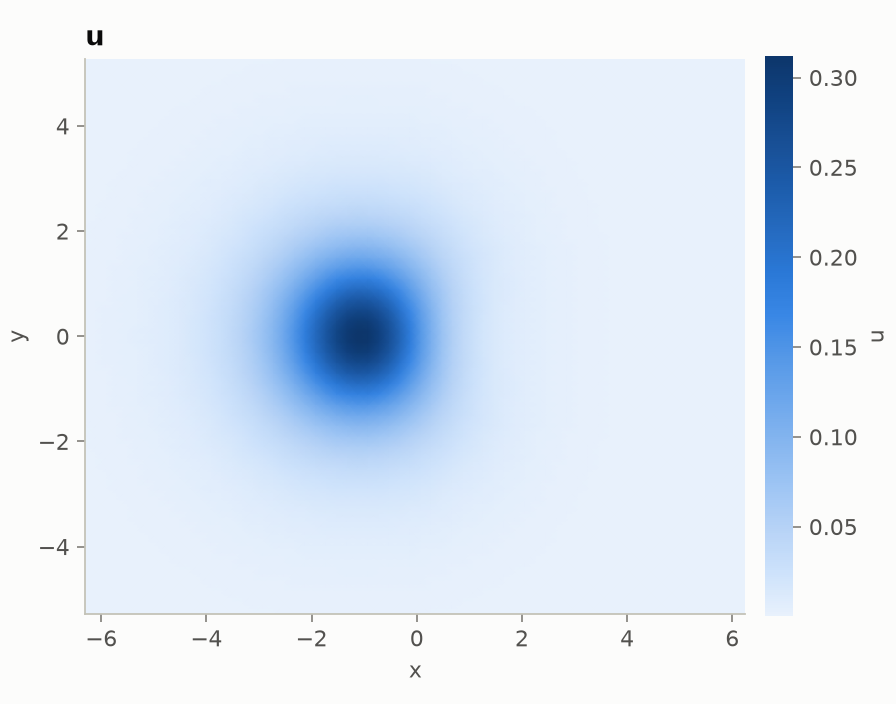
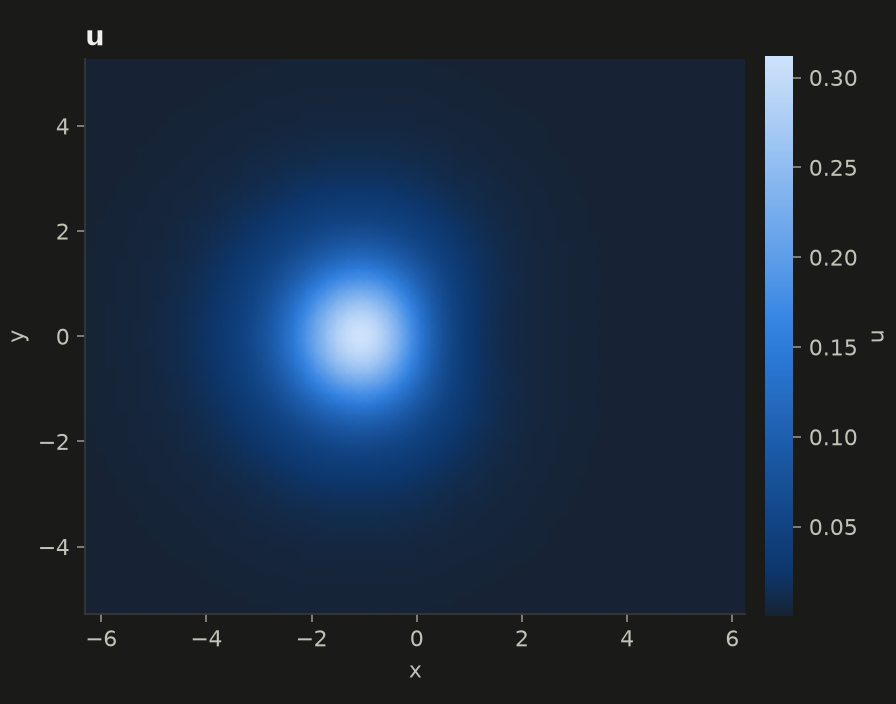
The source sits to the left and the well to the right, where it pushes the solution down.
Any coefficient may vary, also the one of the highest derivatives. Two things are asked of them. They must be smooth on the scale of the grid. And along free directions they must settle to constants away from where they vary, so that the equation far away is a Poisson or a screened Poisson equation. The planner finds those constants and puts the box around the region where the coefficients differ from them.
A dielectric body with a smooth permittivity is such a medium: \(\nabla\cdot(\varepsilon\nabla\varphi) = -4\pi\rho\), with \(\varepsilon\) equal to one away from the body. A body with a sharp surface is described differently: see Bodies.
On a periodic box: free to vary everywhere
On a box that repeats in every direction nothing has to settle, and the equation may be of any order:
ring = pm.Space(x, periodic={x: (0, 2 * sp.pi)})
q = sp.Function("q")(x)

bent_ring = pm.solve(
    pm.Problem(
        sp.Eq(
            (2 + sp.sin(x)) * sp.Derivative(q, x, 2)
            + sp.cos(x) * sp.Derivative(q, x)
            - (1 + sp.cos(x) / 2) * q,
            sp.cos(3 * x),
        ),
        domain=ring,
    )
)
assert bent_ring.diagnostics["iterations"] < 30
The iteration
In free space, on periodic boxes and between walls, such equations are
solved by an iteration on top of the solver for constant coefficients.
plan.method.tolerance and plan.method.max_iterations set when it
stops, and the diagnostics iterations and residual say how it went.
If the iteration does not reach its tolerance, pdemagic raises
pm.ConvergenceError and returns nothing.
Between walls
In a stationary equation on a box every coefficient may vary: a medium inside the derivatives, a coefficient in front of a second or a first derivative, and a potential. Here the solution is known, so that the result can be checked:
medium = 1 + x * y
known = sp.exp(x) * sp.sin(2 * y)
source = sum(sp.diff(medium * sp.diff(known, s), s) for s in (x, y))
plate = pm.Box({x: (0, 1), y: (0, 1)})

in_a_medium = pm.Problem(
    sp.Eq(pm.div(medium * pm.grad(u)) - (1 + x**2) * u, source - (1 + x**2) * known),
    domain=plate,
    boundary=sp.Eq(u, known),
)
found = pm.solve(in_a_medium)

assert found.plan.method.kind == "collocation_iterative"
assert abs(found(0.3, 0.7) - np.exp(0.3) * np.sin(1.4)) < 1e-9
assert found.diagnostics["iterations"] < 20
The iteration takes ten to thirty steps, also for a medium that varies by a factor of a thousand.
On a disk, a ring, a ball, a shell or a cylinder the term without derivatives may vary, as in \(a\,\nabla^2 u + c(\mathbf{x})\,u = f\). Between walls a coefficient is a formula, and the equation must not leave its solution open up to a constant.
On a shape
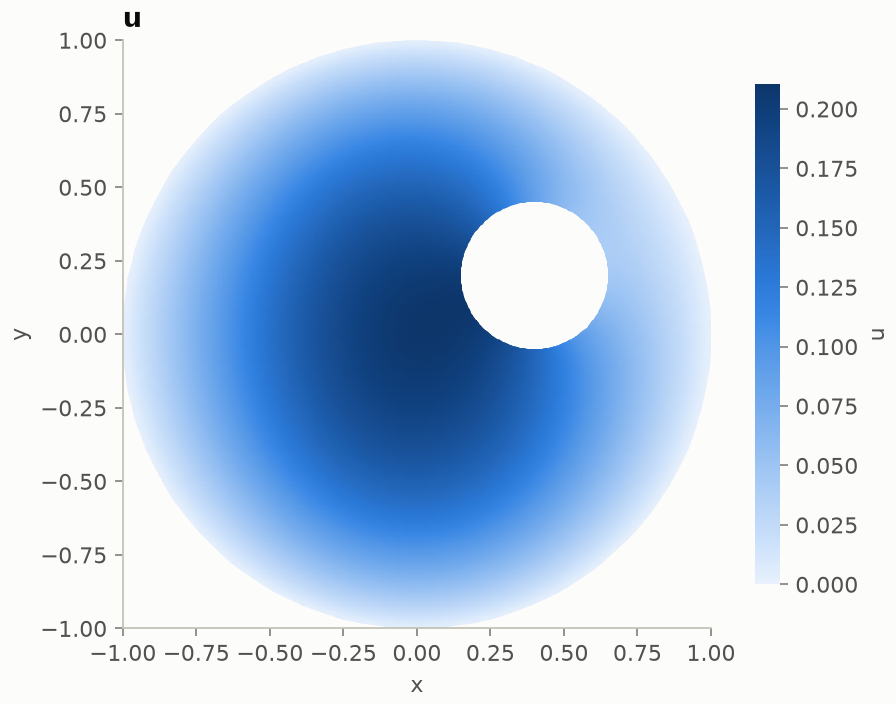
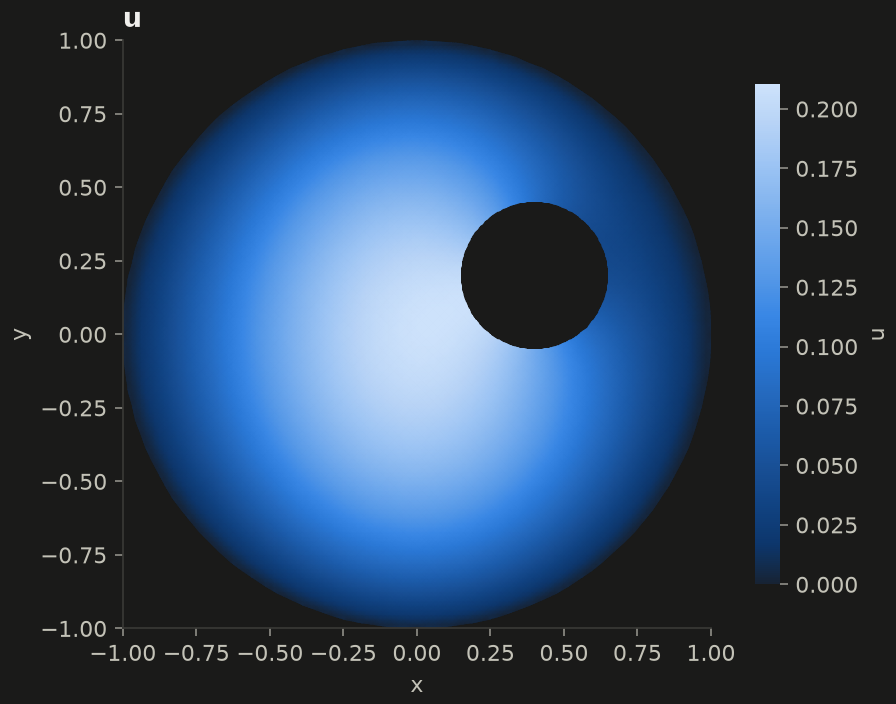
On a shape in the plane any elliptic equation of second order may have coefficients that vary, with nothing asked of them far away. It is solved directly, without an iteration. A plate with a hole that conducts better towards one side, heated evenly:
rim = curves.Circle((0, 0), 1, name="rim")
hole = curves.Circle((0.4, 0.2), 0.25, name="hole")

uneven = pm.Problem(
    sp.Eq(-pm.div((1 + x**2) * pm.grad(u)), 1),
    domain=pm.Region(x, y, rim, hole),
    boundary={rim: sp.Eq(u, 0), hole: sp.Eq(pm.normal_derivative(u), 0)},
)
pm.solve(uneven).plot()
A drift, coefficients that differ along x and y, and a term in the
unknown itself may all vary from place to place and be combined:
(1 + x**2) * u.diff(x, 2) + ... - x**2 * u.
A mixed derivative
A stationary equation may hold a mixed derivative, on a box and on a
shape, with a coefficient that is constant or varies. On a shape it
describes a material whose axes are a little turned. This one conducts
three times as well along y, and on the unit disk the solution is
\((1 - x^2 - y^2)/8\):
disk = pm.Region(x, y, curves.Circle((0, 0), 1))
turned = pm.Problem(
    sp.Eq(-(u.diff(x, 2) + u.diff(x, y) + 3 * u.diff(y, 2)), 1),
    domain=disk,
    boundary=sp.Eq(u, 0),
)
grain = pm.solve(turned)
assert abs(grain(0.3, 0.4) - (1 - 0.25) / 8) < 1e-10
On a box the same kind of equation is solved by the iteration:
def sheared(f):
    return f.diff(x, 2) + f.diff(y, 2) + sp.Rational(4, 5) * f.diff(x, y) - f


across = pm.Problem(
    sp.Eq(sheared(u), sheared(known)), domain=plate, boundary=sp.Eq(u, known)
)
found = pm.solve(across)
assert found.plan.method.kind == "collocation_iterative"
assert abs(found(0.3, 0.7) - np.exp(0.3) * np.sin(1.4)) < 1e-9
The equation must be elliptic: its second derivatives must act with the same sign in every direction, everywhere in the domain. Beside \(a\,u_{xx} + c\,u_{yy}\) a term \(b\,u_{xy}\) needs \(b^2 < 4ac\), and an equation that is not, like \(u_{xx} - u_{yy} = f\), is refused. On a box the iteration takes more steps the closer \(b^2\) comes to \(4ac\): 13 steps for \(b = 0.5\) beside the Laplacian, 30 for \(b = 1.5\), about a hundred for \(b = 1.95\).
A mixed derivative changes what the corners of a box do. The equation is that of a box sheared into a parallelogram, and at a corner that opens wider than a right angle the solution has a singularity, unless what is given on the faces fits. The plan then says that the solution is not resolved.
What does not work yet
In free space, coefficients that do not settle to constants along free directions.
A medium with a sharp surface, other than through bodies.
On round domains, a coefficient that varies anywhere but in the term without derivatives.
A mixed derivative in time, on a round domain, and on domains with free directions.
See also
Reference: what is solved where.
Waves in a medium, and potentials in problems in time and in eigenproblems.
Gallery: a lens of glass, a crystal that conducts askew.
Methods: equations whose coefficients vary in space, the iteration between walls, shapes in the plane.
Recipes for single tasks.