A flash of light
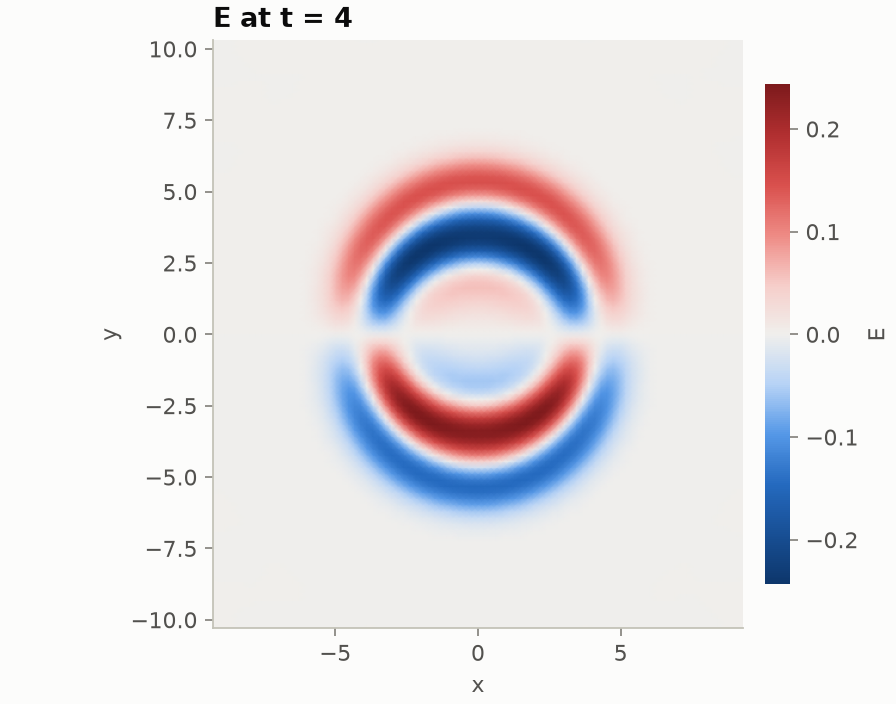
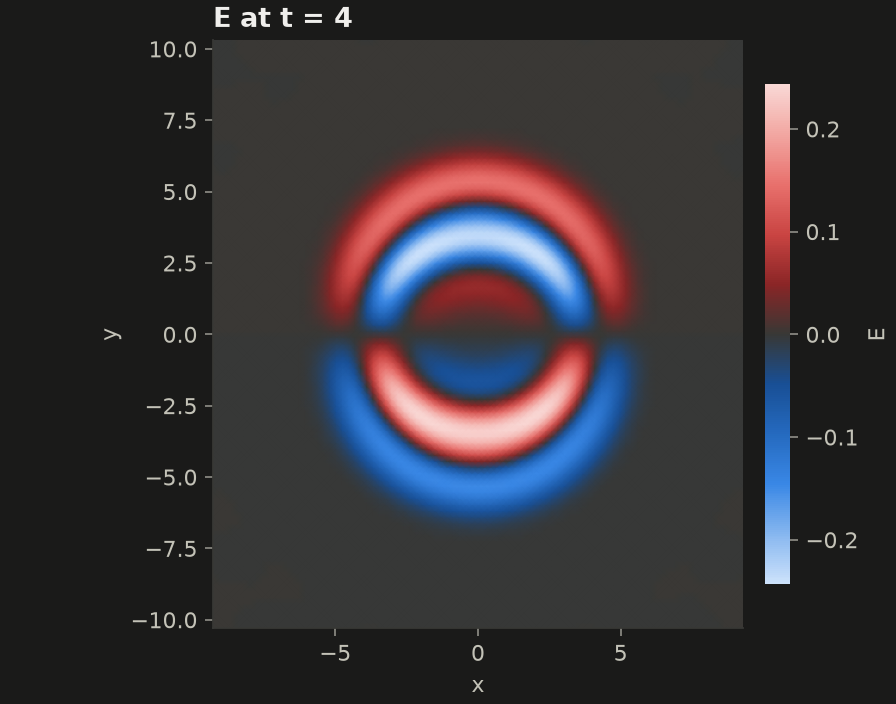
The electric field of two pulses of opposite sign, some time after the flash: each has spread as a ring.
import sympy as sp
import pdemagic as pm

x, y, t = sp.symbols("x y t", real=True)
E = sp.Function("E")(x, y, t)
Hx = sp.Function("Hx")(x, y, t)
Hy = sp.Function("Hy")(x, y, t)
pulses = sp.exp(-(x**2 + (y - 1) ** 2)) - sp.exp(-(x**2 + (y + 1) ** 2))

light = pm.Problem(
    sp.Eq(E.diff(t), Hy.diff(x) - Hx.diff(y)),
    sp.Eq(Hx.diff(t), -E.diff(y)),
    sp.Eq(Hy.diff(t), E.diff(x)),
    domain=pm.FreeSpace(x, y),
    time=(t, 0.0, 4.0),
    initial={E: pulses, Hx: 0, Hy: 0},
)
pm.solve(light).plot(E)
What it shows
Maxwell’s equations in vacuum, for a wave in the plane whose electric field points out of it: three coupled equations of first order for the electric field and the two parts of the magnetic field. The problem takes them as they stand. The two pulses spread as rings with the speed 1, and cancel along the line between them. The solution holds every unknown, and the plot draws the one that is named.
What pdemagic decided
The planner recognised that the three equations describe waves, and
chose exact propagation in Fourier space (fourier_propagator): the
state of every wave has three components, and is propagated by the
exponential of a 3×3 matrix. The box holds everything the waves reach
by the end of the time span, about \(\pm 9.3\) by \(\pm 10.3\), with 87 by
96 points.