Two states of Bratu’s problem
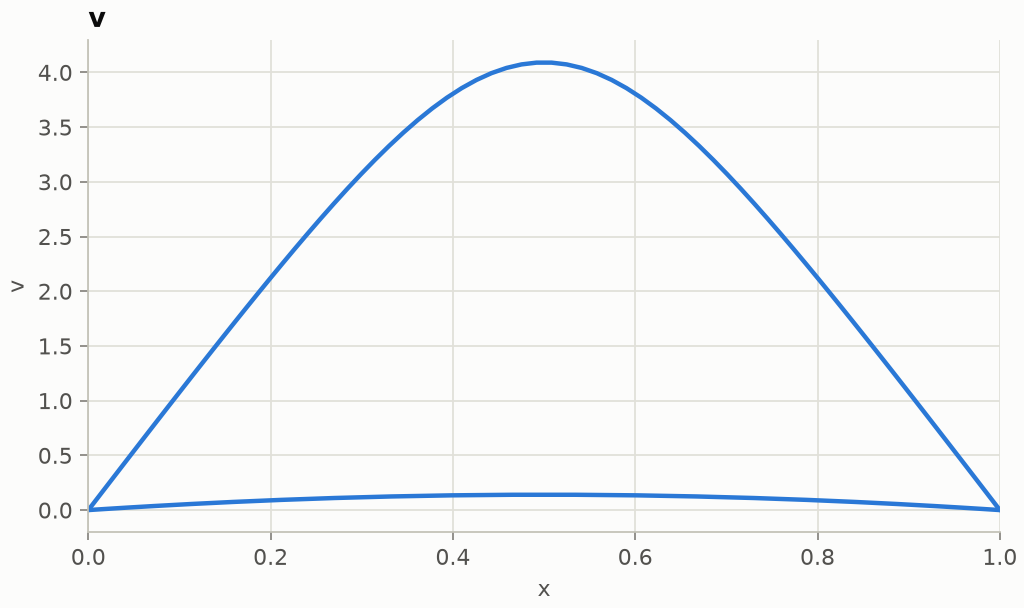
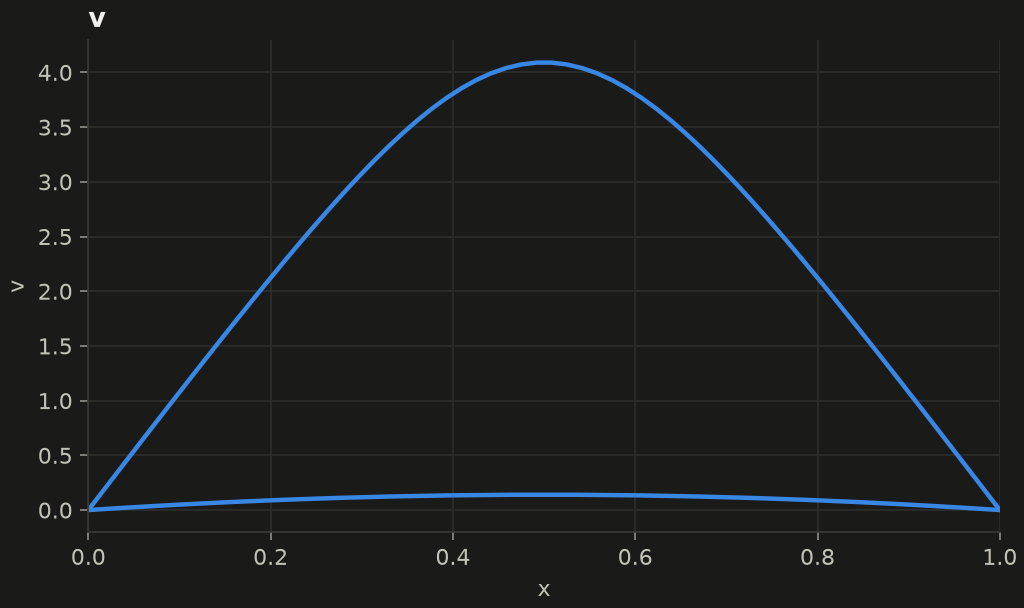
One nonlinear equation between two walls and its two solutions, each found from its own starting value.
import sympy as sp
import pdemagic as pm

x = sp.symbols("x", real=True)
v = sp.Function("v")(x)
walls = pm.Box({x: (0, 1)})
bratu = sp.Eq(v.diff(x, 2) + sp.exp(v), 0)

lower = pm.solve(pm.Problem(bratu, domain=walls, boundary=sp.Eq(v, 0)))
upper = pm.solve(
    pm.Problem(bratu, domain=walls, boundary=sp.Eq(v, 0), guess={v: 16 * x * (1 - x)})
)

axes = lower.plot()
upper.plot(ax=axes)
What it shows
The problem of Bratu, \(v'' + e^v = 0\) with \(v = 0\) at both walls. It is
a model of a substance that heats itself the faster the warmer it is,
between two cold walls. The equation is nonlinear, and it has two
solutions. In the lower one the heating stays weak, and the middle
reaches 0.14. In the upper one the heating feeds itself, and the middle
reaches 4.09. Newton’s method finds the solution that it reaches from
its start: the lower one from zero, and the upper one from the starting
value that guess= gives.
What pdemagic decided
The planner chose Newton’s method on collocation at Chebyshev points
(collocation_newton), and its plan says that it finds the solution
that Newton’s method reaches from its start. Each step is a linear
equation with a coefficient that varies, solved by an iteration on the
direct solve. The lower solution is resolved on 24 points and the upper
one, which is steeper at the walls, on 96.