Two antennas
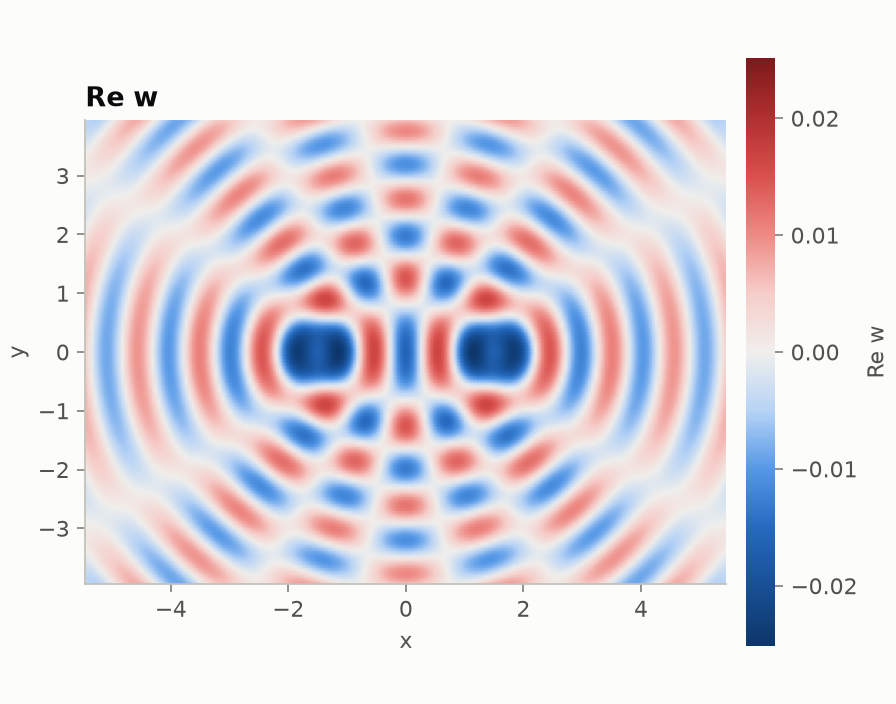
Waves of one frequency from two sources in the plane, which reinforce each other in some directions and cancel in others.
import sympy as sp
import pdemagic as pm

x, y = sp.symbols("x y", real=True)
w = sp.Function("w")(x, y)


def spot(centre):
    return sp.exp(-8 * ((x - centre) ** 2 + y**2))


antennas = pm.Problem(
    sp.Eq(pm.laplacian(w) + 36 * w, -(spot(-1.5) + spot(1.5))),
    domain=pm.FreeSpace(x, y),
)
pm.solve(antennas).plot(part="real")
What it shows
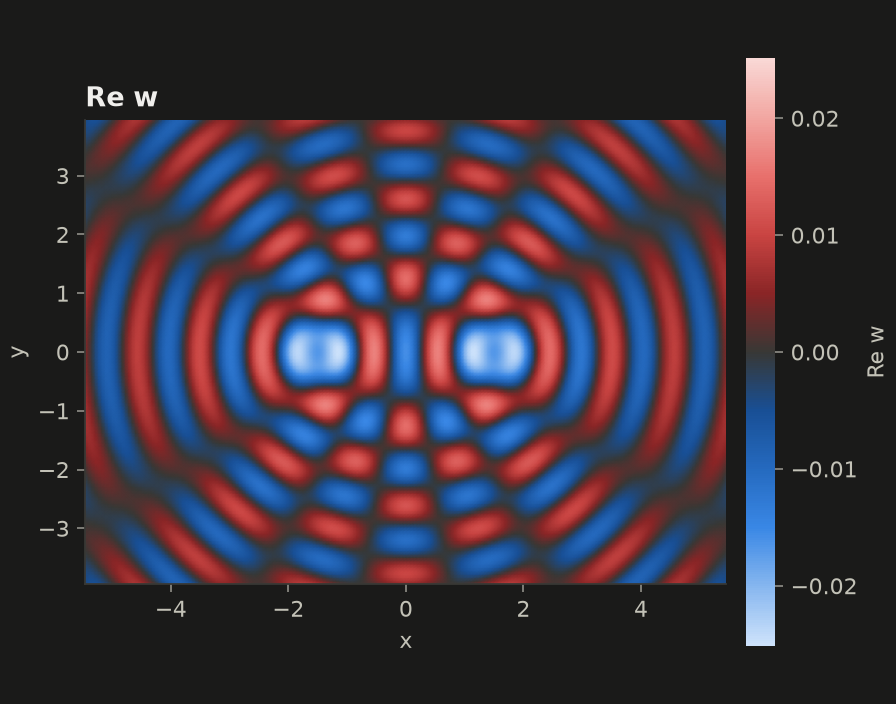
The Helmholtz equation, \(\nabla^2 w + k^2 w = -f\) with \(k = 6\), in free space. There this equation has many solutions, and pdemagic returns the one in which the sources send waves out and nothing comes in from far away. That solution is complex, and the picture shows its real part: the wave at one instant. The two sources swing together, nearly three wavelengths apart. At right angles to the line that joins them their waves add up, and in other directions crest meets trough and the wave stays weak.
What pdemagic decided
The planner recognised a Helmholtz equation with the wavelength 1.05
and chose the Fourier method (fourier), with the outgoing wave of a
point source in the place of its potential. It left two wavelengths of
room around the sources and gave every wavelength at least six grid
points, so that the waves can be seen: 192 by 139 points.