Give each face its own condition
Use this when the faces of a box or a round domain differ: one is heated, another is insulated, a third is kept cold.
Steps
Look up the faces:
domain.faces. A face is named by the coordinate that is constant on it and the end it lies at, so(x, 0)is the face wherexis 0.Write one equation for each face: the value
sp.Eq(u, g), the slopesp.Eq(u.diff(x), g), or a mix of both.Pass them as a mapping from each face to its equation, as
boundary=.
Example
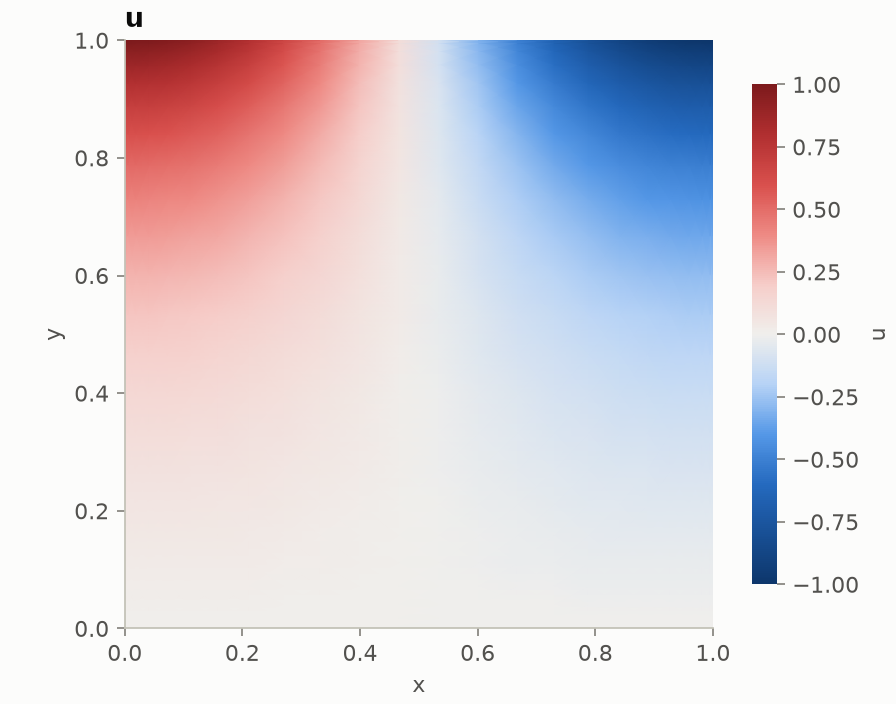
A plate that is insulated on its left and right side, kept cold at the bottom, and heated along the top:
import numpy as np
import sympy as sp
import pdemagic as pm

x, y = sp.symbols("x y", real=True)
u = sp.Function("u")(x, y)

box = pm.Box({x: (0, 1), y: (0, 1)})
assert box.faces == ((x, 0.0), (x, 1.0), (y, 0.0), (y, 1.0))

conditions = {
    (x, 0): sp.Eq(u.diff(x), 0),  # the slope: nothing flows through
    (x, 1): sp.Eq(u.diff(x), 0),
    (y, 0): sp.Eq(u, 0),  # the value
    (y, 1): sp.Eq(u, sp.cos(sp.pi * x)),
}
plate = pm.Problem(sp.Eq(pm.laplacian(u), 0), domain=box, boundary=conditions)
heated = pm.solve(plate)
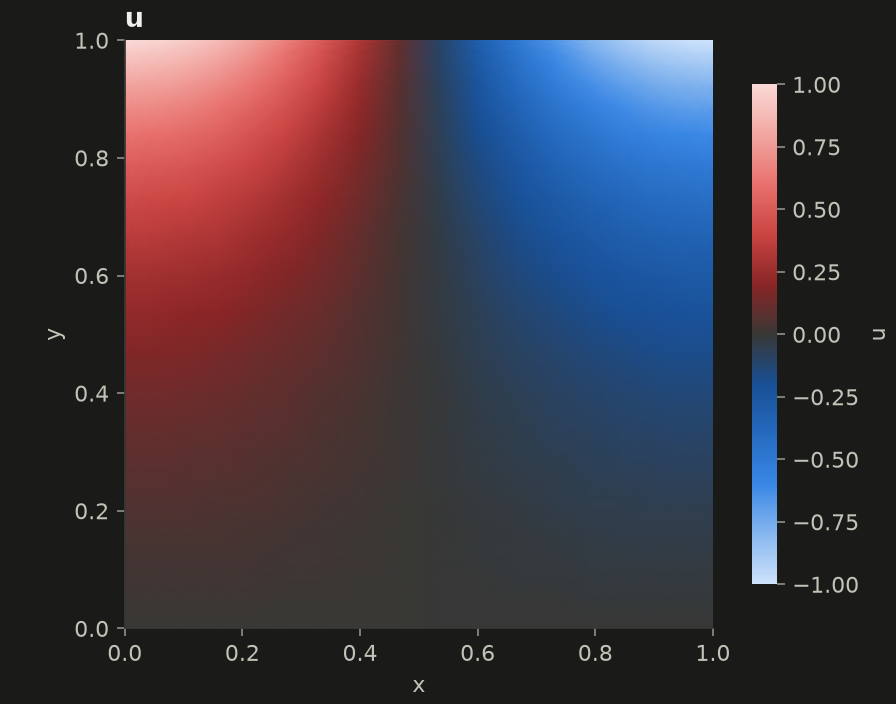
heated.plot()

X, Y = heated.mesh()
exact = np.cos(np.pi * X) * np.sinh(np.pi * Y) / np.sinh(np.pi)
assert abs(heated[u] - exact).max() < 1e-12
Notes
Every face needs a condition. A face that is left out is refused, and so is a key that is no face: the message lists the faces.
When most faces share a condition, start from
dict.fromkeys(box.faces, sp.Eq(u, 0))and replace the others.u.diff(x)is the slope along the coordinate, not along the outward normal. At an upper face the two agree, at a lower face they differ in sign.pm.normal_derivative(u)is the slope along the outward normal on every face.A condition has the form \(a\,u + b\,\partial u/\partial x = g\) with numbers \(a\) and \(b\). What is given, \(g\), is a number, a formula in the coordinates or an array, and in a problem in time it may depend on the time.
A disk has the one face
(r, radius), a ring two, and a cylinder a wall and two caps.On a shape in the plane the keys are curves and their pieces: see Name the pieces of a boundary.
Boundary conditions and Boxes with walls explain more, and the gallery has a heated plate.