A membrane on an L
A membrane in the shape of an L, held along its edge, that sags under an even load.
import sympy as sp
import pdemagic as pm
from pdemagic import curves

x, y = sp.symbols("x y", real=True)
u = sp.Function("u")(x, y)
corners = [(0, 0), (1, 0), (1, 1), (-1, 1), (-1, -1), (0, -1)]
room = pm.Region(x, y, curves.Polygon(*corners))

membrane = pm.Problem(sp.Eq(-pm.laplacian(u), 1), domain=room, boundary=sp.Eq(u, 0))
pm.solve(membrane).plot()
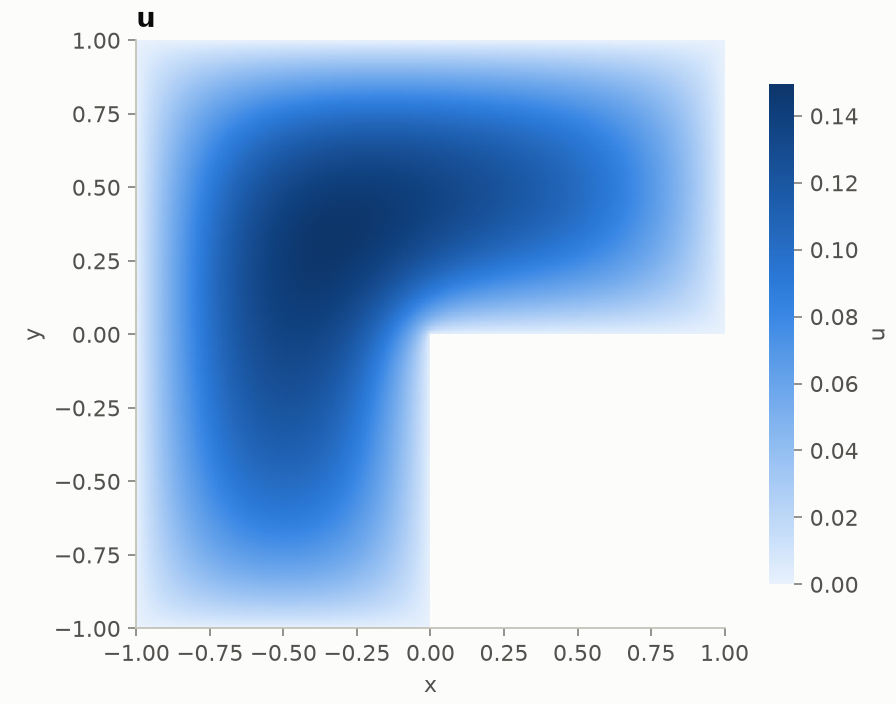
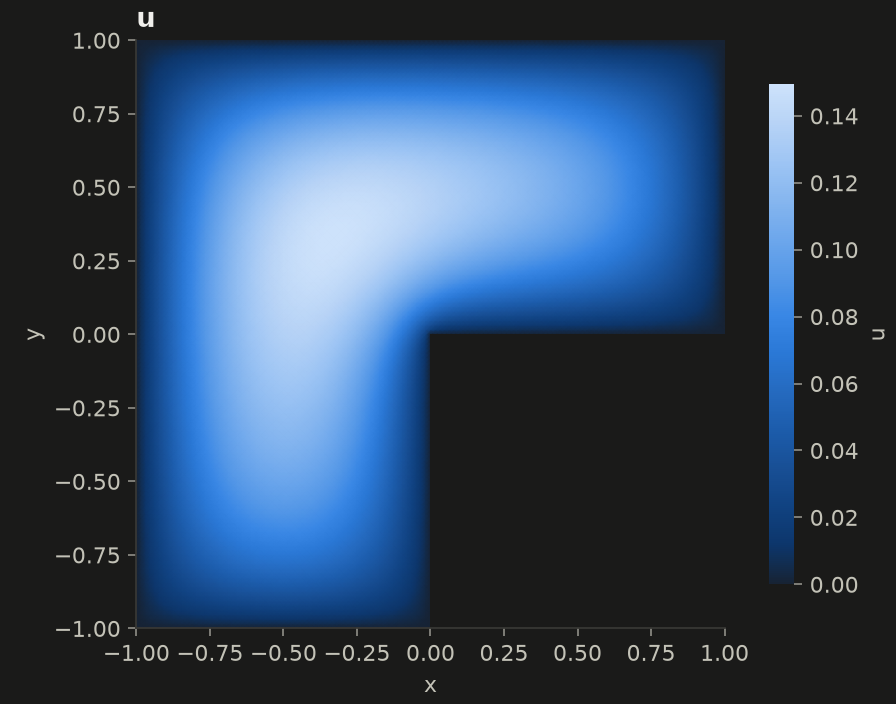
What it shows
Poisson’s equation, \(-\nabla^2 u = 1\), on a polygon. One equation as
boundary holds on all six sides. The membrane sags most in the bend
of the L, and it comes down steeply at the corner that points into it.
That corner is the hard part of the problem: the slope of the solution
grows without bound towards it, and no polynomial follows that.
What pdemagic decided
The planner chose spectral elements (spectral_elements), and it found
the corner. The plan says that the solution has a singularity there,
and lets the elements shrink towards the corner in 18 layers, each half
the size of the one before: 828 quadrilaterals in all. With the layers
the solution is right to ten digits, at the corner too. Without them,
four digits are all that comes easily.