A particle in a stadium
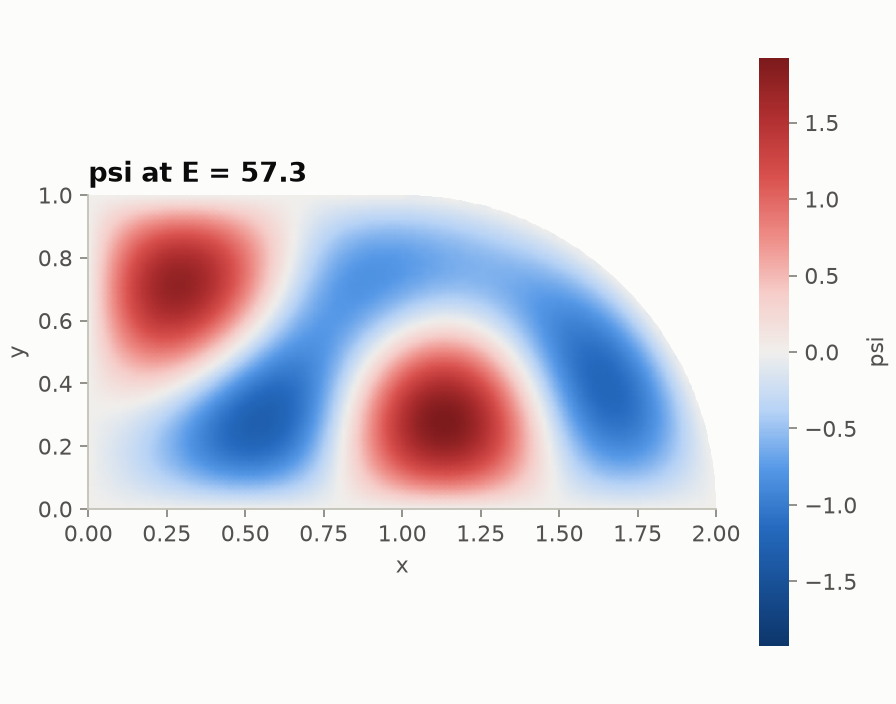
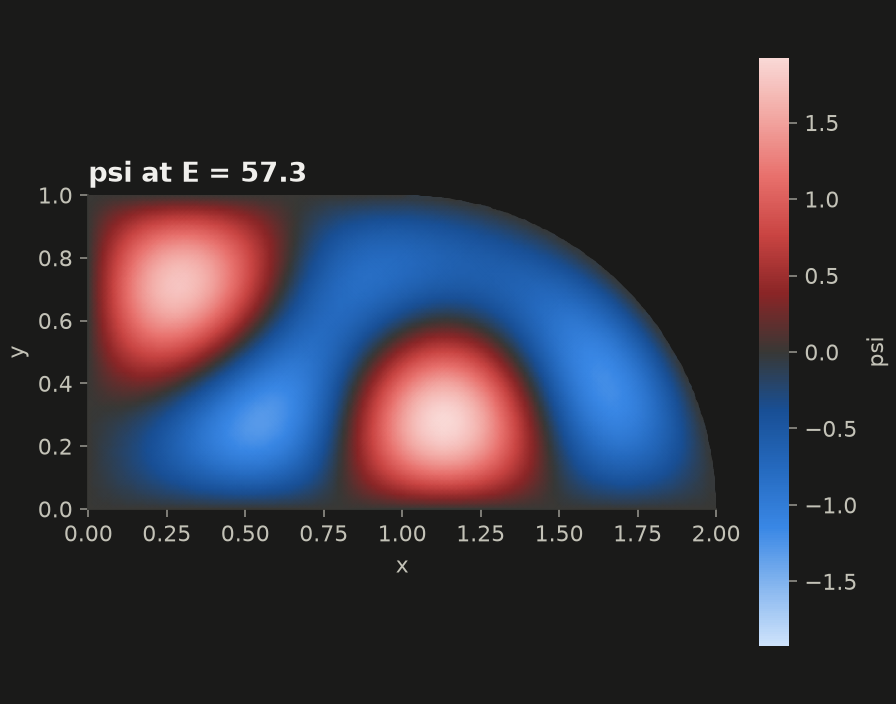
A mode of a quarter of a stadium: mirrored across its two straight cuts with the sign changed, it is the 27th mode of the whole.
import math

import sympy as sp
import pdemagic as pm
from pdemagic import curves

x, y = sp.symbols("x y", real=True)
E = sp.Symbol("E")
psi = sp.Function("psi")(x, y)
quarter = curves.Curve(
    curves.Arc((1, 0), 1, 0, math.pi / 2),
    curves.Line((1, 1), (0, 1)),
    curves.Line((0, 1), (0, 0)),
    curves.Line((0, 0), (2, 0)),
)

billiard = pm.Problem(
    sp.Eq(-pm.laplacian(psi), E * psi),
    domain=pm.Region(x, y, quarter),
    boundary=sp.Eq(psi, 0),
    eigenvalue=(E, 6),
)
pm.solve(billiard).plot(state=5)
What it shows
A stadium is two half circles joined by straight lines. A ball that rolls in it without friction moves chaotically, and the stadium is the classic place to ask what the states of a quantum particle look like where that is so. The states are the modes of the region with the value zero on its boundary. Every mode of the whole stadium is even or odd across each of its two axes, and those that are odd across both are the modes of one quarter, whose boundary is a curve put together from an arc and three lines. A quarter reaches high modes with few of them: its sixth, with \(E = 57.30\), is the 27th of the whole stadium. Its nodal lines cross the quarter at a slant and follow neither the straight wall nor the arc.
What pdemagic decided
The planner chose the modes of the shape on spectral elements
(element_modes), by an iteration on a block of functions. It went up
to the degree 12, on 201 quadrilaterals with 29 221 points, and its plan
says that the Legendre coefficients of the modes have fallen to
\(1.5\cdot10^{-7}\) there, that the modes have a singularity, and that a
higher degree gains little. Where the arc meets the straight wall the
boundary changes its curvature at once, and a mode is not smooth there.
The mode is given on 129 by 65 points.