A struck drum
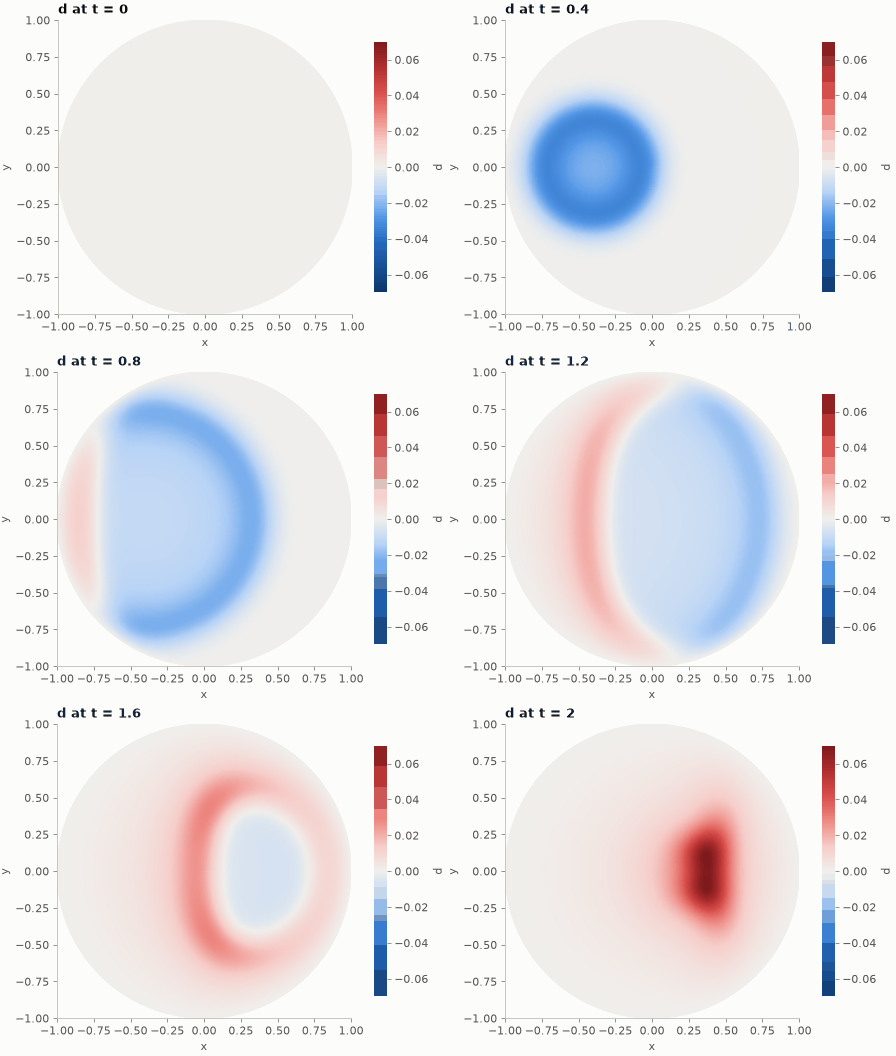
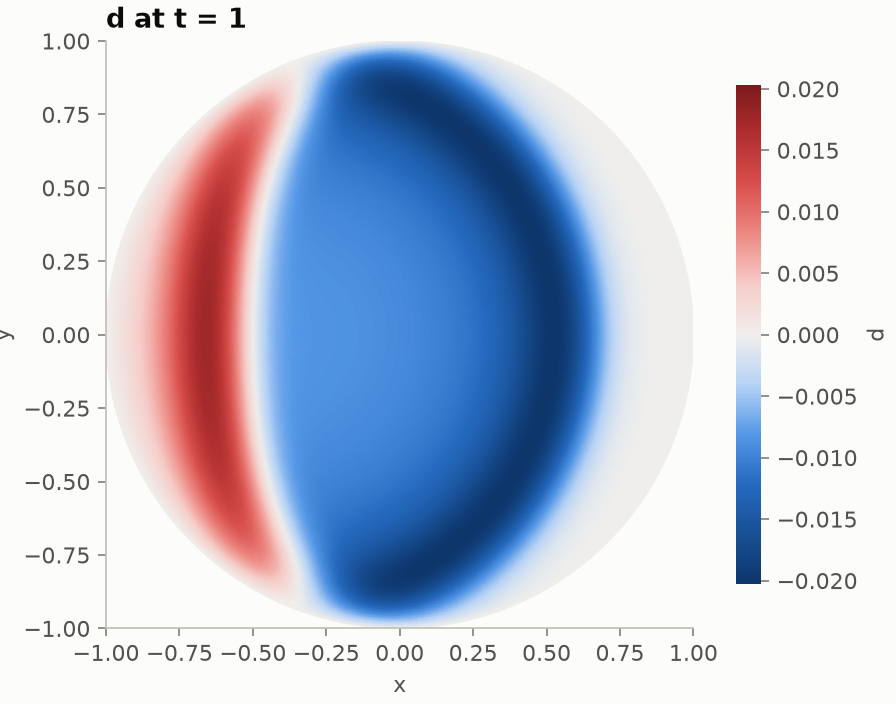
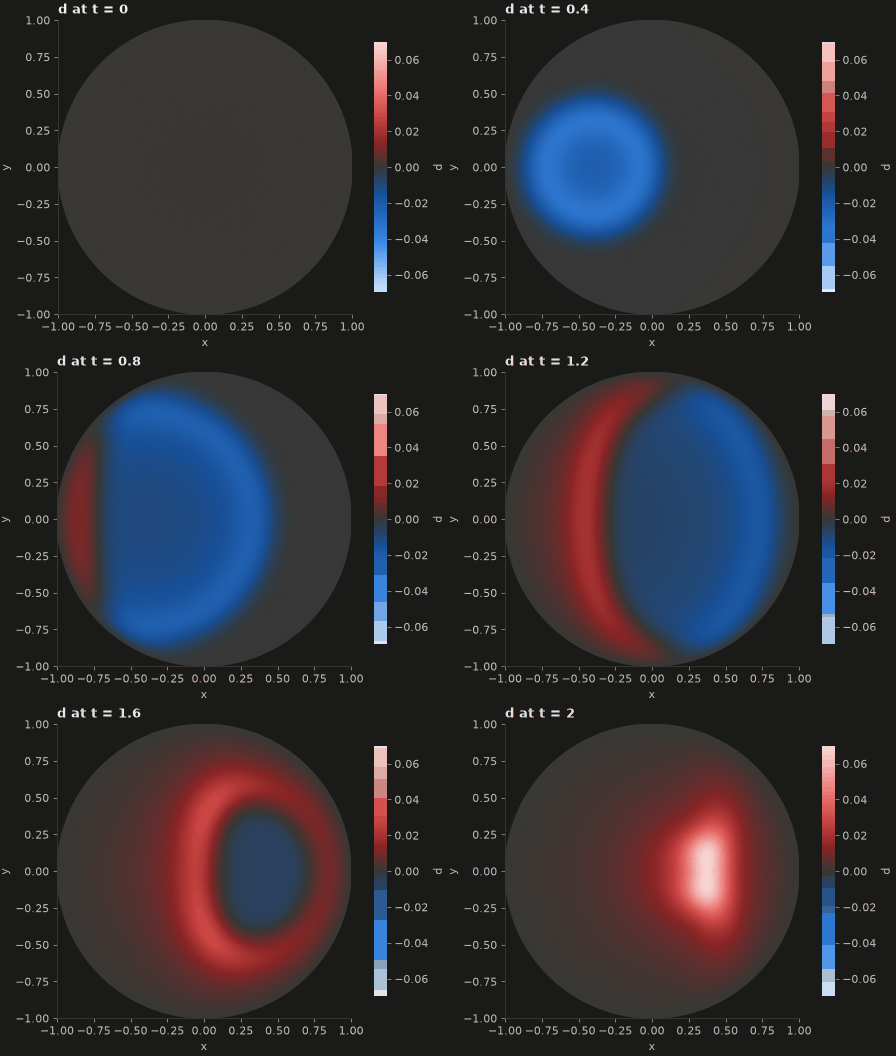
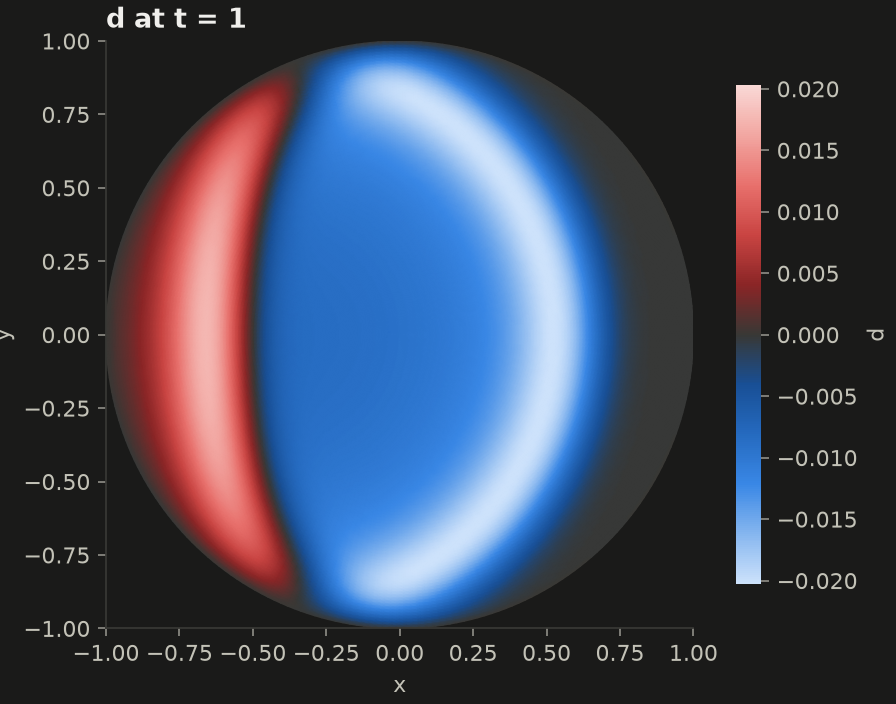
A round drum one unit of time after a blow off its centre: the dent has become a ring, and the near rim has thrown it back.
import sympy as sp
import pdemagic as pm

r, phi, t = sp.symbols("r phi t", real=True)
d = sp.Function("d")(r, phi, t)
disk = pm.Disk(r, phi, radius=1)
X, Y = disk.cartesian
blow = -sp.exp(-60 * ((X + 0.4) ** 2 + Y**2))

drum = pm.Problem(
    sp.Eq(d.diff(t, 2), pm.laplacian(d)),
    domain=disk,
    time=(t, 0, 2),
    initial={d: 0, d.diff(t): blow},
    boundary=sp.Eq(d, 0),
)
ringing = pm.solve(drum)
ringing.plot(time=1.0)
film = ringing.animate()
What it shows
The wave equation on a disk whose rim is held. The skin starts flat,
and the blow gives it a velocity, under the key d.diff(t) of the
initial state. The dent that the blow makes spreads as a ring with the
speed 1. In the picture the ring has crossed most of the drum. Its left
part has met the rim and come back with the opposite sign, as a wave
does where it is held. The animation shows all recorded times, one
frame for each.
What pdemagic decided
The planner chose exact propagation in the modes of the disk
(mode_propagator), with 64 Gauss points along the radius and 128
Fourier waves along the angle. Nothing that is given depends on time,
so each of the 21 recorded times is exact in time.