pdemagic at a glance
pdemagic solves partial differential equations that you state as you would write them down. It chooses the method, the grid and every setting, solves the problem, and tells you what it did. This page shows the whole idea with one example.
A problem is equations on a domain
A problem is a set of sympy equations on a domain. The unknown is an undefined function of the coordinates. Here a source in the plane sends out waves of one frequency, which is the Helmholtz equation \(\nabla^2 w + k^2 w = -f\) with \(k = 6\):
import sympy as sp
import pdemagic as pm

x, y = sp.symbols("x y", real=True)
w = sp.Function("w")(x, y)

source = sp.exp(-8 * (x**2 + y**2))
problem = pm.Problem(
    sp.Eq(pm.laplacian(w) + 36 * w, -source),
    domain=pm.FreeSpace(x, y),
)
FreeSpace is the whole plane. Nothing in the problem says how to solve
it: there is no grid, no box, and no artificial boundary that would have
to absorb the waves.
The planner chooses method and grid
pm.solve hands the problem to the planner, which recognises the
equation and decides how to solve it, and then solves it. The solution
holds numpy arrays, with the grid they live on.
solution = pm.solve(problem)
solution.plot(part="real")
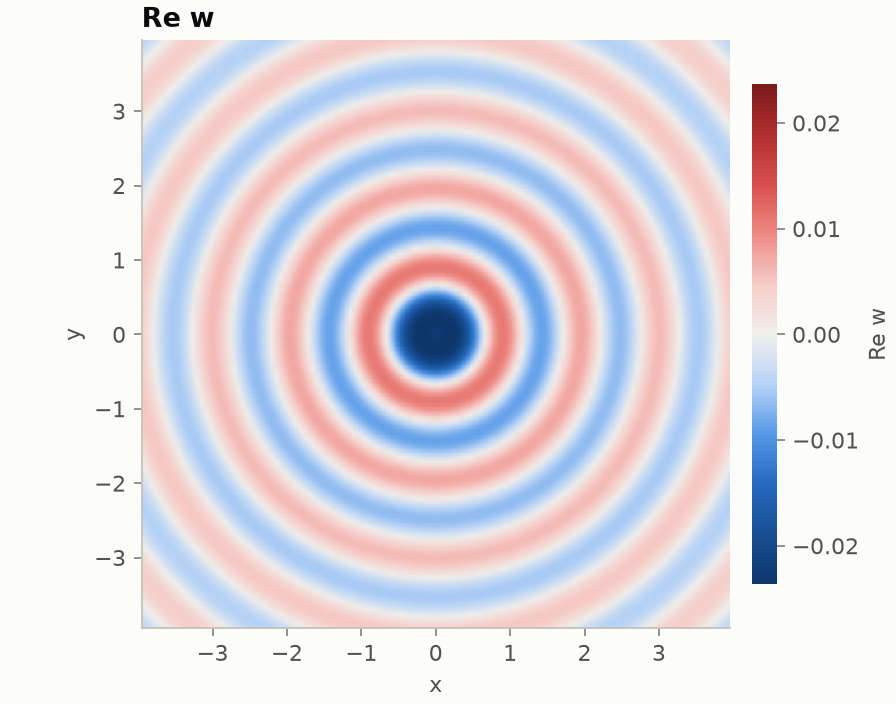
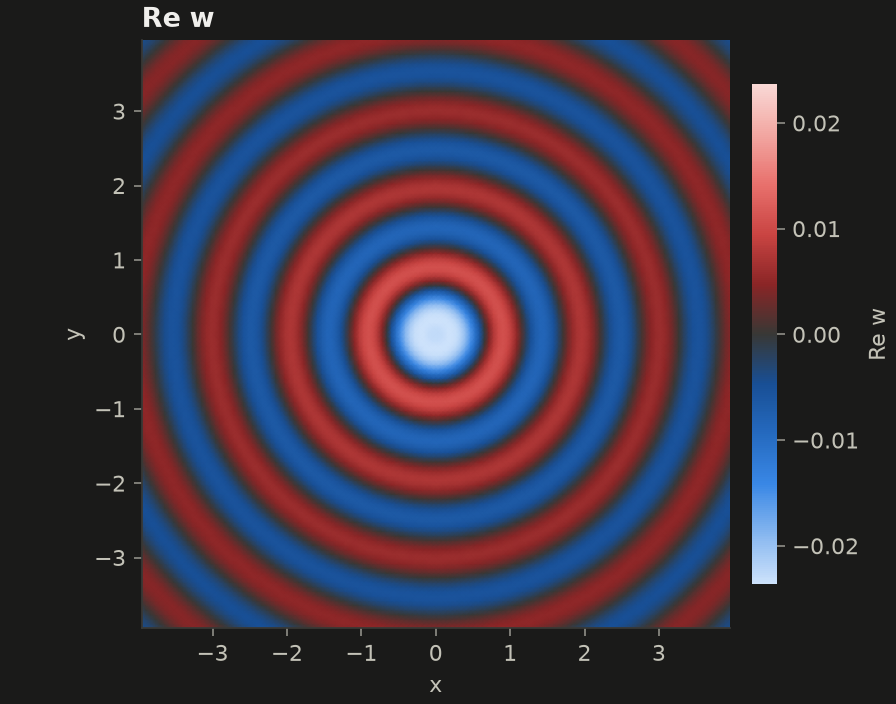
The waves leave the source and do not come back, as they do in free space.
The plan is data
What the planner decided is a plan. You can print it before anything is solved:
plan = pm.plan(problem)
print(plan)
method:
  kind: fourier
grid:
  lower: [-3.952980960979054, -3.952980960979054]
  upper: [3.9529809609790543, 3.9529809609790543]
  shape: [128, 128]
  periodic: [False, False]
notes:
  - The equation is a Helmholtz equation with the wavelength 1.0472, in 2-dimensional free space.
  - Box: chosen so that the source falls to 1e-12 of the maximum at the faces.
  - The box is 2 wavelengths wider than the source on every free side, and the grid has at least 6 points per wavelength, so that the waves around the source can be seen. The solution is the outgoing one, and is complex.
  - Grid: the coarsest candidate on which the spectrum of the source falls below 1e-10 at high frequencies.
The notes say in words what the planner found and why it chose what it chose. Every entry can be changed, and the plan is then executed exactly as given:
plan.grid.shape = (192, 192)
finer = pm.solve(problem, plan)
assert finer[w].shape == (192, 192)
Accurate by default
Most methods are spectral, and linear equations in time are propagated exactly. Ten digits on a modest grid are common. Every solution carries diagnostics that say how far it can be trusted:
assert solution.diagnostics["spectral_tail"] < 1e-10
The numerics are written in Rust. Python is the first frontend.
What it solves
pdemagic is young, and it does not solve everything. In short:
Stationary equations: Poisson’s equation in many settings, screened and with a medium, the Helmholtz equation, equations with coefficients that vary, nonlinear equations, beams and plates. See Stationary equations and Waves of one frequency.
Problems in time: heat, waves, the Schrödinger equation, and nonlinear equations. See Problems in time.
Eigenproblems: the bound states of a potential, and the modes of a string, a drum, a room. See Eigenproblems and Modes of cavities, drums and waveguides.
Systems of equations and complex unknowns. See Systems of equations and Complex unknowns.
A problem lives on one of these domains:
Free space and periodic directions: unbounded, with no artificial boundary, or a box that repeats.
Boxes with walls: an interval, a rectangle, a box in any number of dimensions, with a condition on each face.
Shapes in the plane that you draw yourself from lines and arcs.
Not every equation is solved on every domain. What is solved where has the table, and Domains helps you choose.
Where to go from here
Install pdemagic, and then take the tutorial, which starts with a first problem.