A drum
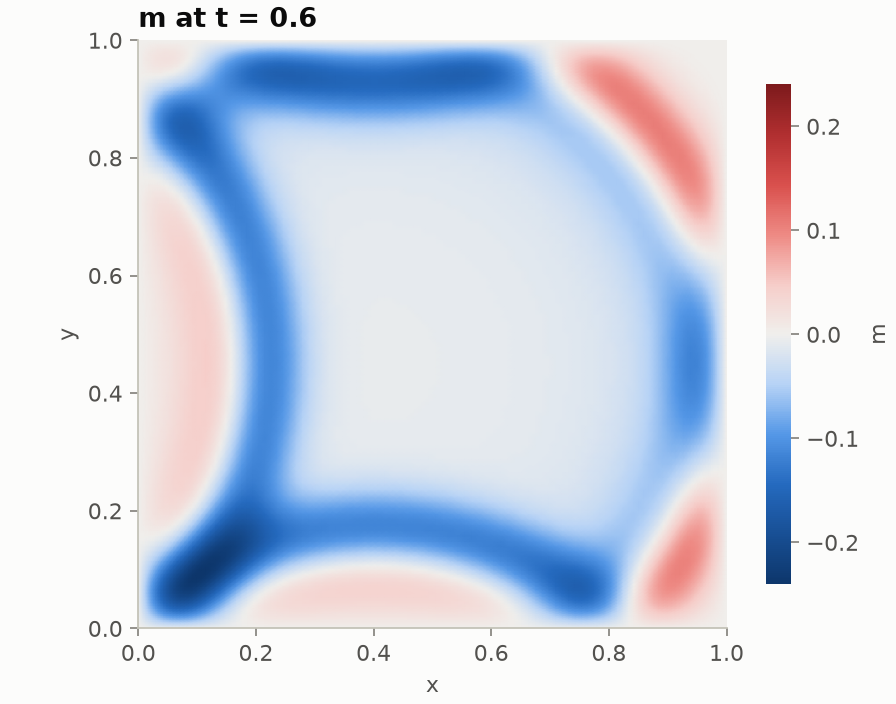
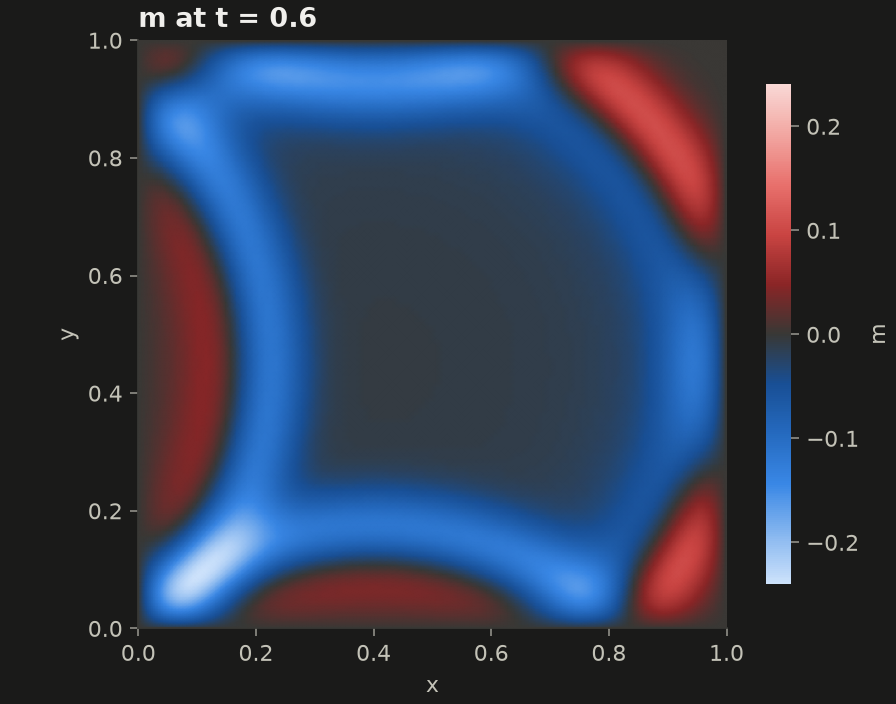
A square membrane that is held at its rim, a moment after it was let go from a dent off its centre.
import sympy as sp
import pdemagic as pm

x, y, t = sp.symbols("x y t", real=True)
m = sp.Function("m")(x, y, t)
dent = sp.exp(-200 * ((x - 0.4) ** 2 + (y - 0.45) ** 2))

drum = pm.Problem(
    sp.Eq(m.diff(t, 2), pm.laplacian(m)),
    domain=pm.Box({x: (0, 1), y: (0, 1)}),
    time=(t, 0, 1),
    initial={m: dent, m.diff(t): 0},
    boundary=sp.Eq(m, 0),
)
pm.solve(drum).plot(time=0.6)
What it shows
The wave equation on a square with walls, \(m_{tt} = \nabla^2 m\). One
equation as boundary holds on all four faces: the membrane is held
there. The dent spreads as a ring with the speed 1. At \(t = 0.6\) the
ring has reached all four walls, the nearest first. Each wall throws it
back with the opposite sign, and the parts that came back cross the
parts that are still on their way out.
What pdemagic decided
The planner chose exact propagation in the modes of the box
(mode_propagator), on Chebyshev points along both axes. Nothing that
is given depends on time, so each of the 21 recorded times is exact in
time. The dent is narrow, and the planner took 128 by 128 points to
resolve it.