A soliton of light
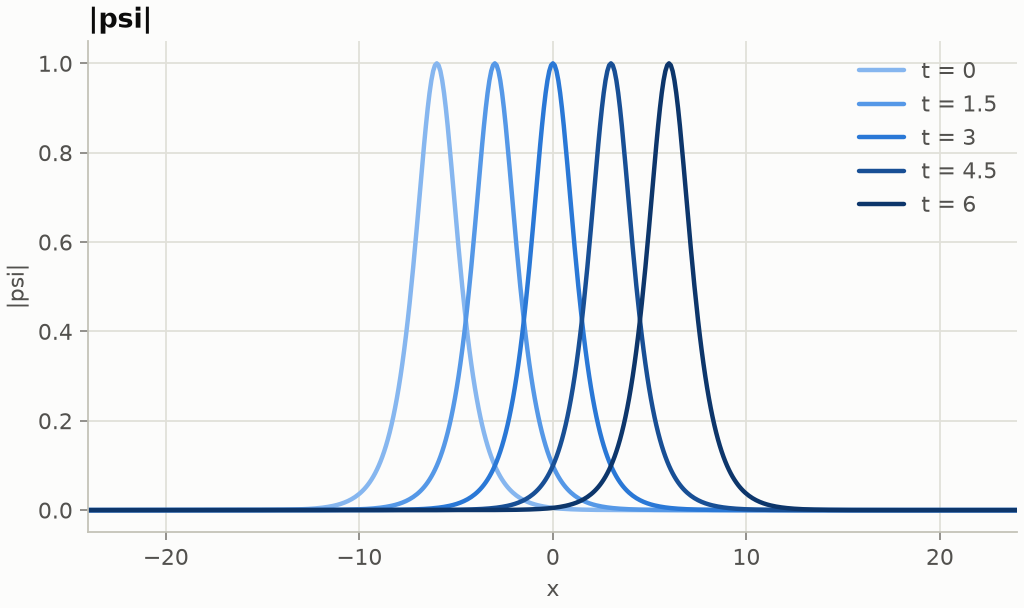
The magnitude of a pulse of light in a glass fibre at five times: it moves and does not spread.
import sympy as sp
import pdemagic as pm

x, t = sp.symbols("x t", real=True)
psi = sp.Function("psi")(x, t)

fibre = pm.Problem(
    sp.Eq(sp.I * psi.diff(t), -psi.diff(x, 2) / 2 - sp.Abs(psi) ** 2 * psi),
    domain=pm.Space(x, periodic={x: (-24, 24)}),
    time=(t, 0, 6),
    initial={psi: sp.exp(2 * sp.I * x) / sp.cosh(x + 6)},
)
pm.solve(fibre).plot()
What it shows
The nonlinear Schrödinger equation, \(i\,\psi_t = -\tfrac12\psi_{xx} -
|\psi|^2\psi\), which describes the envelope of a pulse of light in a
fibre. The unknown is complex, because the equation contains sp.I,
and the plot shows its magnitude. The second derivative alone makes a
pulse spread, as the quantum wave packet
does. The cubic term, sp.Abs(psi) ** 2 * psi, pulls it together. For
the pulse \(1/\cosh x\) the two are in balance: it moves with the speed
2 that its phase \(e^{2ix}\) gives it, and keeps its height and its
width. At the end the solution agrees with the formula for this
soliton to seven digits.
What pdemagic decided
The planner chose exponential time stepping of fourth order
(exponential_runge_kutta): the second derivative is exact, and the
cubic term is stepped, in 640 steps that each err by less than
\(10^{-10}\) of the solution. The grid has 512 points, the finest that
the planner tries by itself. Its plan says that the spectrum of the
initial state has only fallen to \(5\cdot10^{-10}\) there, a little short
of its aim, because the pulse fades slowly towards the ends of the
period.