Waves through a lens
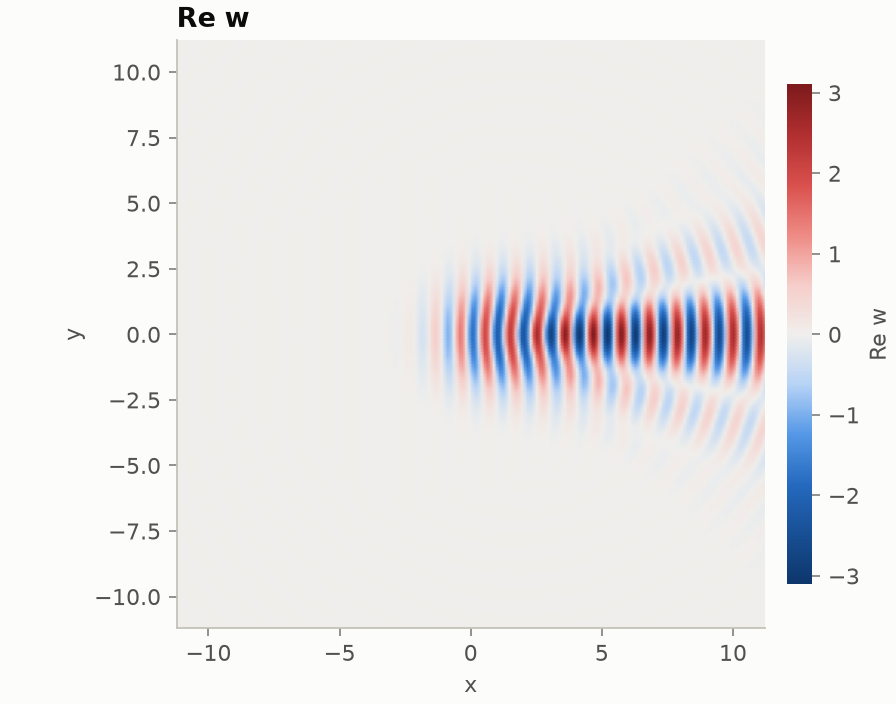
What a lens adds to a wave that comes in from the left: almost nothing in front of it, and a beam behind it.
import sympy as sp
import pdemagic as pm

x, y = sp.symbols("x y", real=True)
w = sp.Function("w")(x, y)
k = 6
denser = sp.exp(-(x**2 + y**2) / 3) / 2  # n² − 1
incoming = sp.exp(sp.I * k * x)

lens = pm.Problem(
    sp.Eq(pm.laplacian(w) + k**2 * (1 + denser) * w, -(k**2) * denser * incoming),
    domain=pm.FreeSpace(x, y),
)
pm.solve(lens).plot(part="real")
What it shows
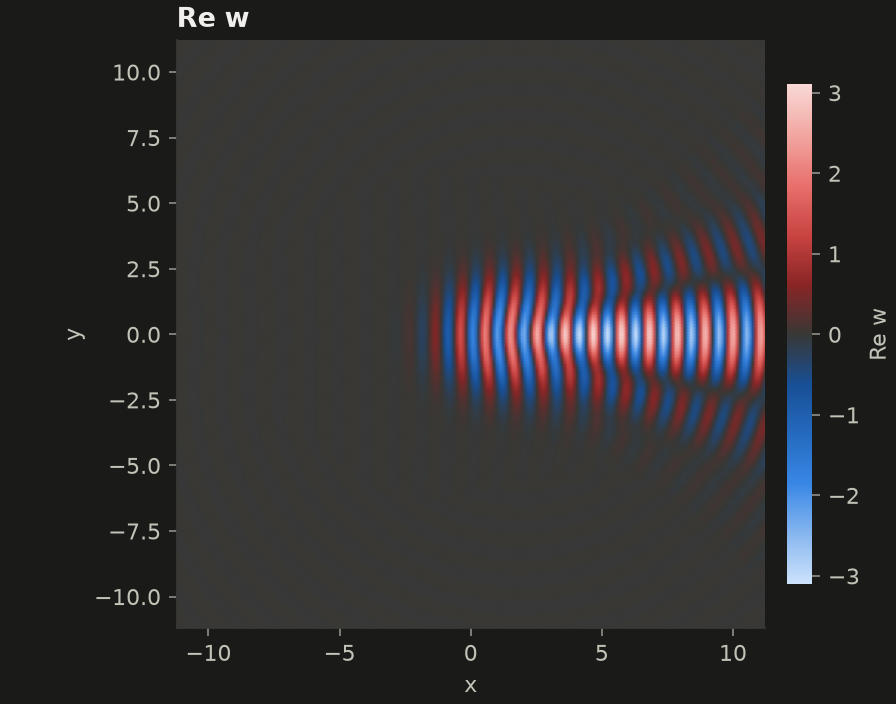
The Helmholtz equation in a medium, \(\nabla^2 u + k^2 n^2 u = 0\). The index of refraction \(n\) is larger where waves travel more slowly, and the lens is a round region in which \(n^2\) rises smoothly from 1 to 1.5. A wave that comes in from far away is not a source inside a box, so it is split off: the unknown \(w\) is what the lens adds to the incoming wave \(e^{ikx}\), and the incoming wave becomes its source. The picture shows that addition: the lens sends hardly anything back, and behind it the added wave forms a beam along the axis. In that beam the whole wave, incoming and added, is up to 2.1 times as strong as it came in.
What pdemagic decided
A coefficient that varies makes this an equation that is solved by an
iteration on the solver for constant coefficients
(fourier_iterative), here in 16 steps. Away from the lens the equation
is a Helmholtz equation with the wavelength 1.05. The planner left two
wavelengths of room around the lens and gave every wavelength at least
six points where the waves are shortest: 192 by 192 points.