An L-shaped drum
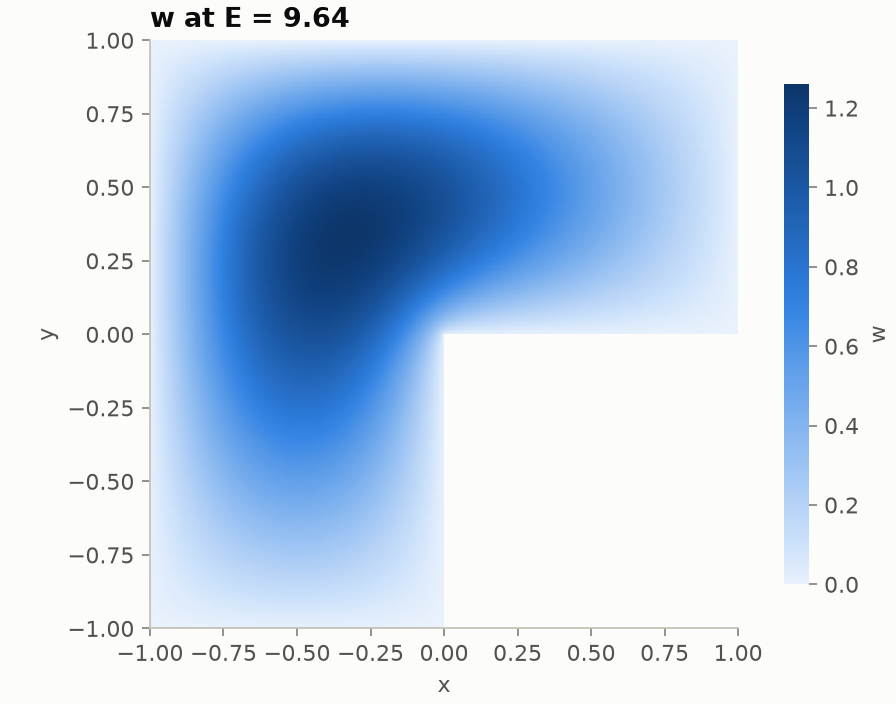
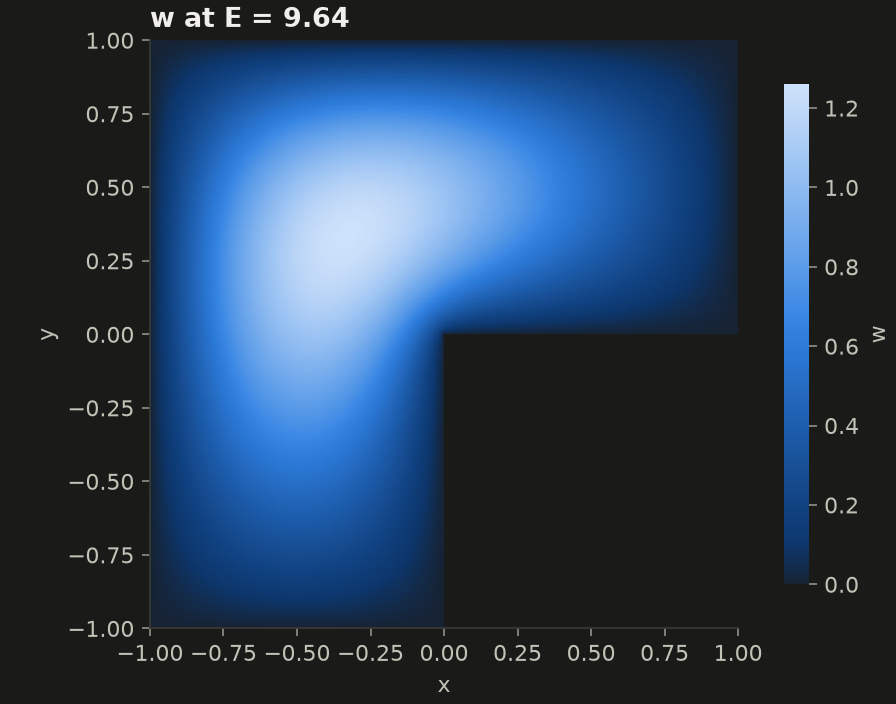
The lowest mode of a membrane in the shape of an L: it bulges in the bend and fades into the two arms, and no formula gives it.
import sympy as sp
import pdemagic as pm
from pdemagic import curves

x, y = sp.symbols("x y", real=True)
E = sp.Symbol("E")
w = sp.Function("w")(x, y)
corners = [(0, 0), (1, 0), (1, 1), (-1, 1), (-1, -1), (0, -1)]

drum = pm.Problem(
    sp.Eq(-pm.laplacian(w), E * w),
    domain=pm.Region(x, y, curves.Polygon(*corners)),
    boundary=sp.Eq(w, 0),
    eigenvalue=(E, 3),
)
pm.solve(drum).plot()
What it shows
The modes of a region that a polygon bounds: \(-\nabla^2 w = E\,w\) with
the membrane held along its edge. eigenvalue=(E, 3) asks for the
three lowest, and a plot draws the lowest unless state= names
another. The lowest has the eigenvalue 9.6397238, a number that no
formula gives. At the corner that points into the L the slope of the
mode grows without bound. The third mode is \(\sin(\pi x)\sin(\pi y)\),
which fits the L as it fits each of its three squares, and has \(E =
2\pi^2\).
What pdemagic decided
The planner chose the modes of the shape on spectral elements
(element_modes). Because a mode has a singularity at the corner that
points inwards, the elements shrink towards it in 18 layers, each half
the size of the one before: 978 quadrilaterals. The degree is 8, the
lowest at which none of the three eigenvalues differs from the one at
the degree before by more than \(10^{-9}\) of its size. The modes are
given on 129 by 129 points over the square that holds the L.