A round drum
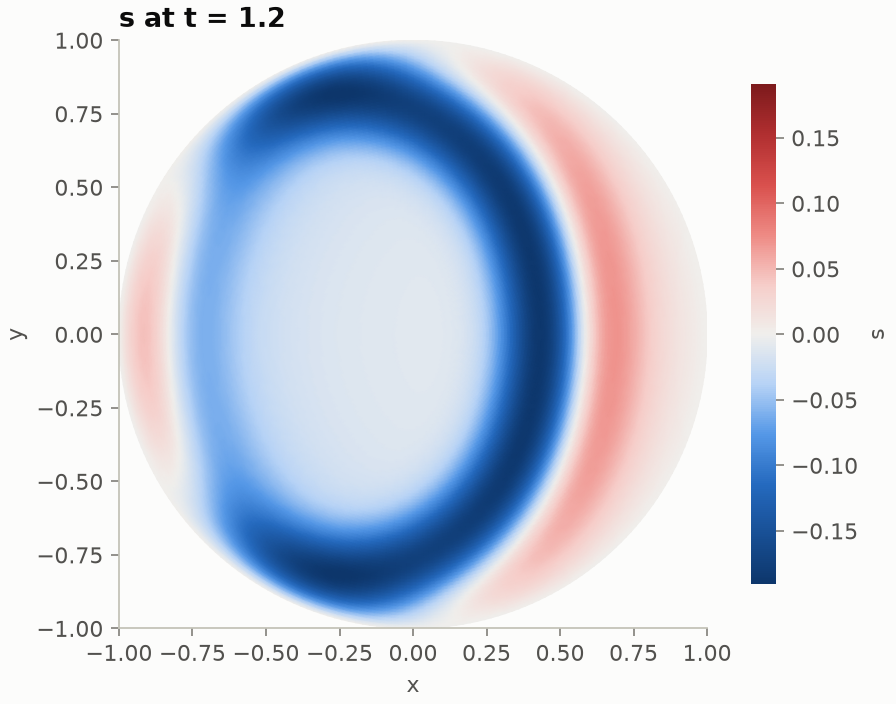
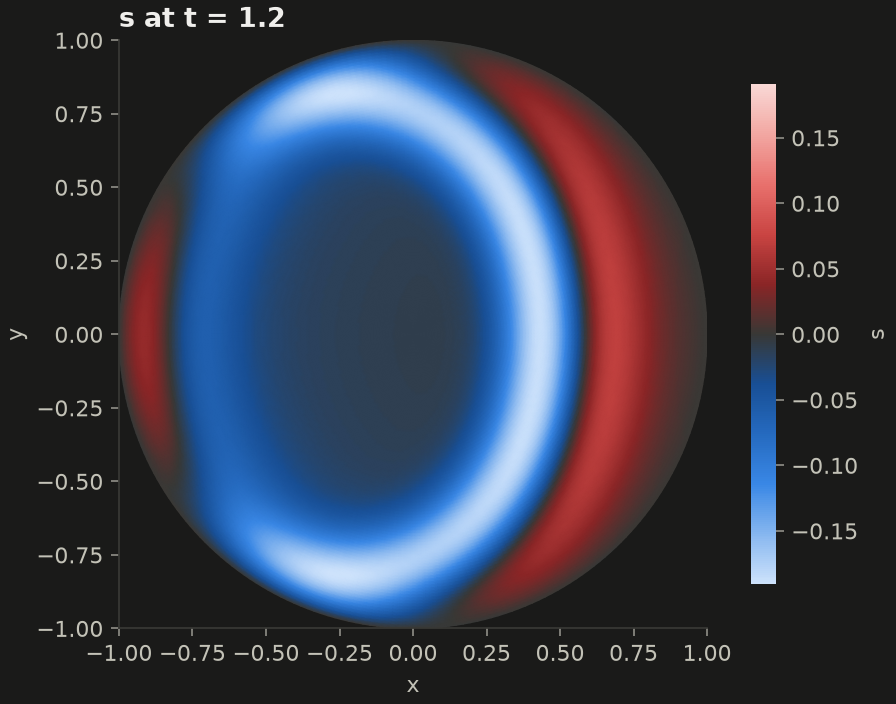
A round membrane that is held at its rim, let go from a dent off its centre: the wave has reached the rim and comes back.
import sympy as sp
import pdemagic as pm

r, angle, t = sp.symbols("r alpha t", real=True)
s = sp.Function("s")(r, angle, t)
disk = pm.Disk(r, angle, radius=1.0)
X, Y = disk.cartesian
dent = sp.exp(-40 * ((X - 0.3) ** 2 + Y**2))

kettledrum = pm.Problem(
    sp.Eq(s.diff(t, 2), pm.laplacian(s)),
    domain=disk,
    time=(t, 0, 2),
    initial={s: dent, s.diff(t): 0},
    boundary=sp.Eq(s, 0),
)
pm.solve(kettledrum).plot(time=1.2)
What it shows
The wave equation on a disk, in polar coordinates, with the same
pm.laplacian as on a square: it takes its form from the domain. The
rim is the one face of the disk, and the membrane is held there.
disk.cartesian gives the Cartesian coordinates as expressions in r
and alpha, which places the dent off the centre. At \(t = 1.2\) the
ring that the dent became has met the rim on the right, which has
thrown it back with the opposite sign, and is about to reach it on the
left.
What pdemagic decided
The planner chose exact propagation in the modes of the disk
(mode_propagator), with 64 Gauss points along the radius and 128
Fourier waves along the angle. Each of the 21 recorded times is exact
in time. The plan notes that the spectrum of the solution has fallen to
\(3\cdot10^{-10}\) there and that finer grids gain little.