A clamped plate
A square plate that is clamped along all four sides and bends under an even load.
import sympy as sp
import pdemagic as pm

x, y = sp.symbols("x y", real=True)
u = sp.Function("u")(x, y)
plate = pm.Box({x: (0, 1), y: (0, 1)})
clamped = [sp.Eq(u, 0), sp.Eq(pm.normal_derivative(u), 0)]

bending = pm.Problem(
    sp.Eq(pm.laplacian(pm.laplacian(u)), 1), domain=plate, boundary=clamped
)
pm.solve(bending).plot()
What it shows
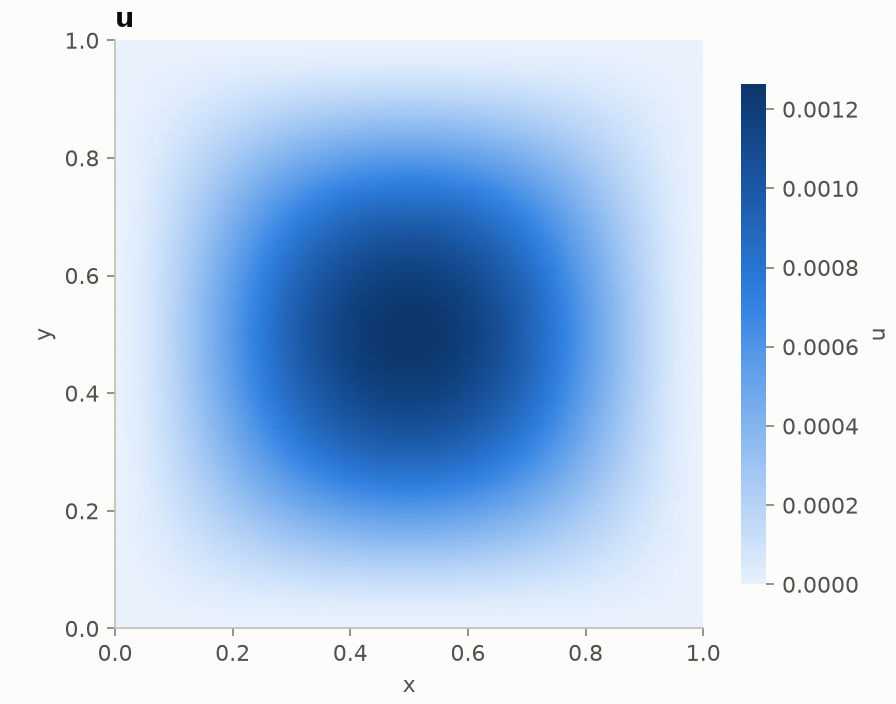
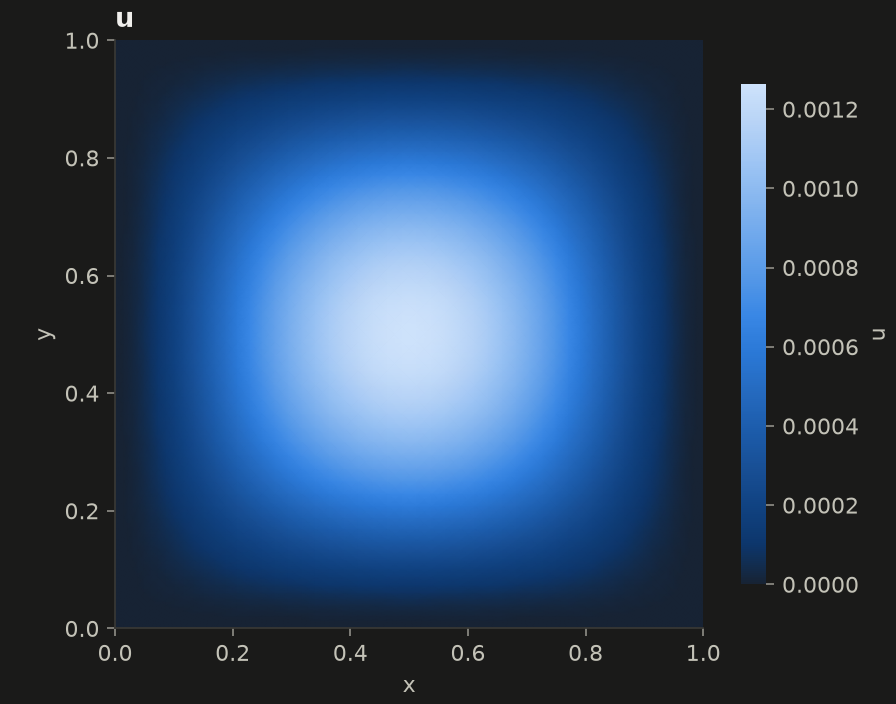
The plate equation, \(\nabla^4 u = 1\), an equation of fourth order. Such an equation takes two conditions on each face, which are given as a list of two equations. A clamped side is held in its value and in its slope. That shows in the picture: the deflection leaves the sides flat and rises only further in, unlike a membrane, which leaves its edge with a slope. The deflection in the middle is 0.00126532, the number that the books on plates give for a clamped square.
What pdemagic decided
The planner split the equation into two of second order, joined on the
faces (collocation_split). Each of the two takes one condition on
each face and is solved directly by collocation at Chebyshev points.
What the second unknown is on the faces is found so that both
conditions hold. The grid has 64 by 64 points, the coarsest candidate
that resolves the solution to \(10^{-10}\).