A crystal that conducts askew
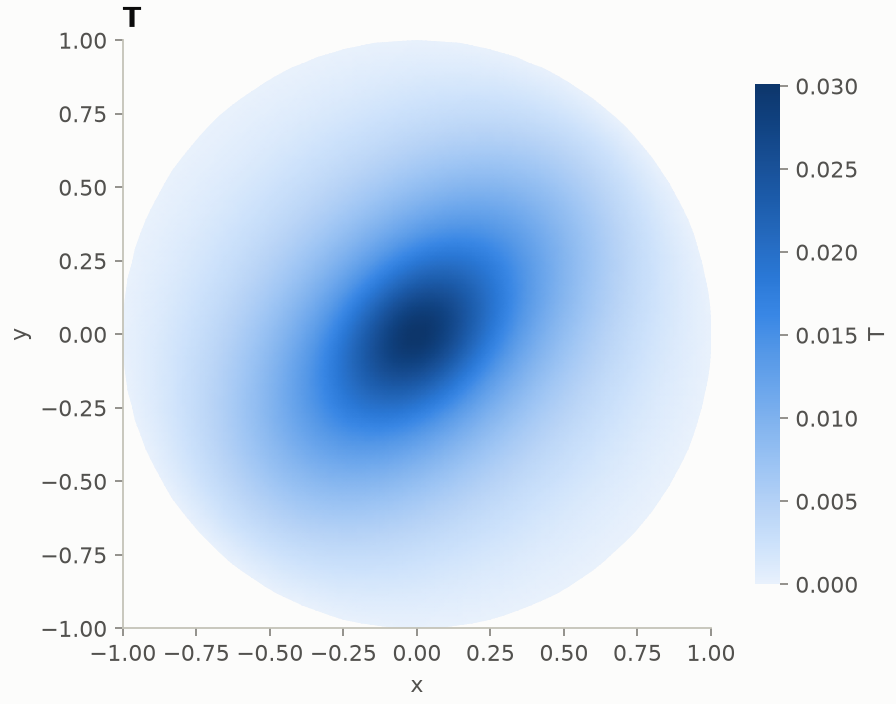
A round plate cut from a crystal that conducts heat four times as well along one diagonal, with a flame under its middle.
import sympy as sp
import pdemagic as pm
from pdemagic import curves

x, y = sp.symbols("x y", real=True)
T = sp.Function("T")(x, y)
flame = sp.exp(-40 * (x**2 + y**2))
plate = pm.Region(x, y, curves.Circle((0, 0), 1))

crystal = pm.Problem(
    sp.Eq(-(T.diff(x, 2) + T.diff(y, 2) + 1.2 * T.diff(x, y)), flame),
    domain=plate,
    boundary=sp.Eq(T, 0),
)
pm.solve(crystal).plot()
What it shows
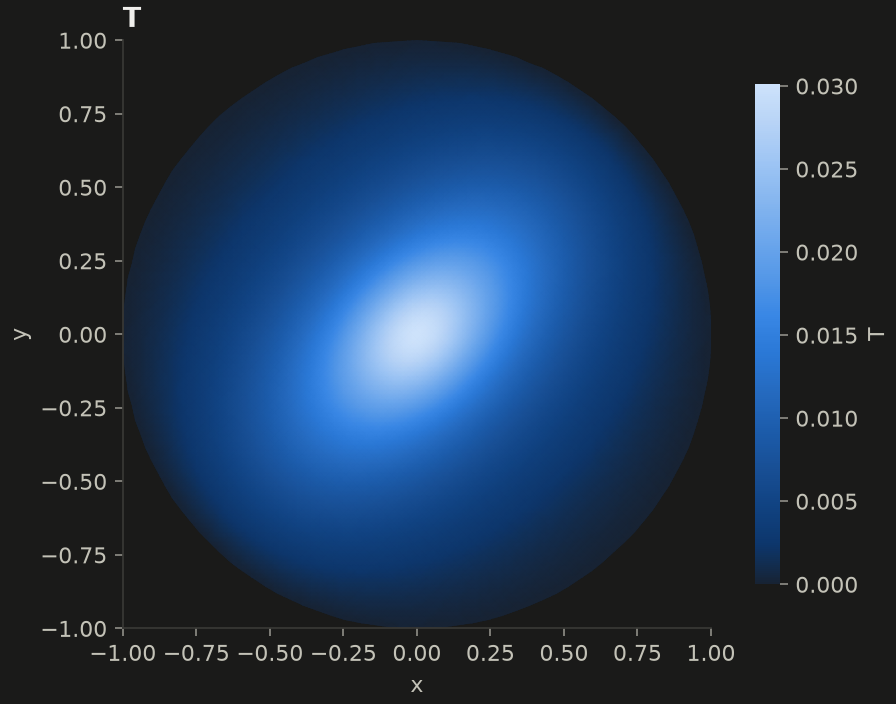
Heat in a medium whose directions differ. A mixed derivative in the equation, \(T_{xx} + T_{yy} + b\,T_{xy}\), means that the axes of the crystal are turned against the coordinates. With \(b = 1.2\) the crystal conducts with the strength 1.6 along the diagonal \(y = x\) and with 0.4 across it. Around the flame the lines of equal temperature are ellipses that lie along that diagonal. Towards the rim, which is kept cold, they become round. The equation must be elliptic, which asks for \(|b| < 2\) here.
What pdemagic decided
On a region of the plane any elliptic equation of second order is
solved directly by spectral elements (spectral_elements), and the
mixed derivative is one more term of it. The planner cut the disk into
330 quadrilaterals and resolved the solution and the flame to
\(10^{-10}\) in each of them. The values are given on 129 by 129 points.