Ions around a charged rod
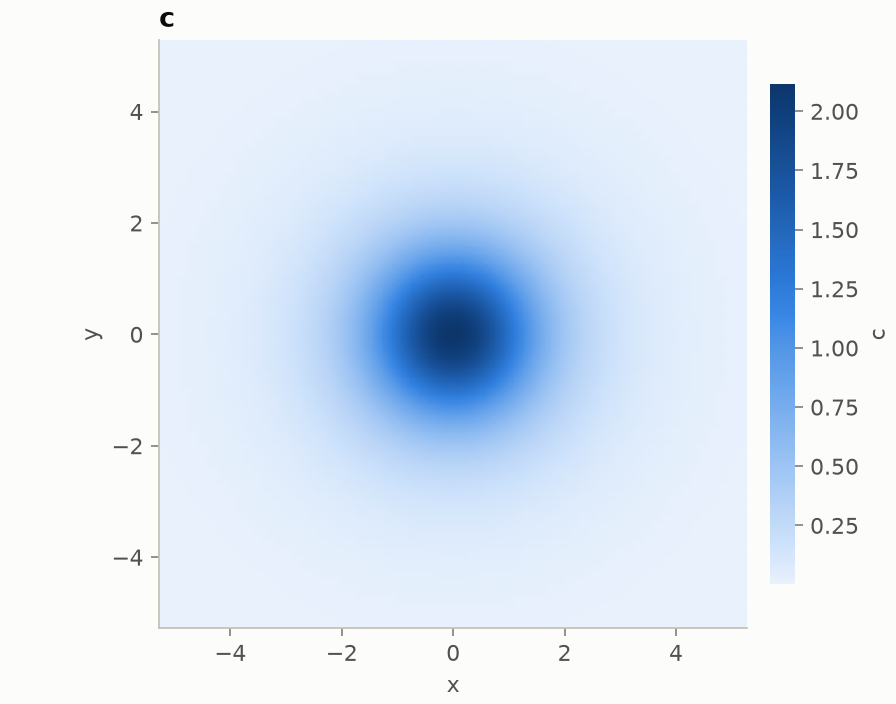
The potential around a charged rod in salt water, where the ions that screen it respond to it exponentially.
import sympy as sp
import pdemagic as pm

x, y = sp.symbols("x y", real=True)
c = sp.Function("c")(x, y)
rod = 8 * sp.exp(-(x**2 + y**2))

electrolyte = pm.Problem(
    sp.Eq(-pm.laplacian(c) + sp.sinh(c), rod), domain=pm.FreeSpace(x, y)
)
pm.solve(electrolyte).plot()
What it shows
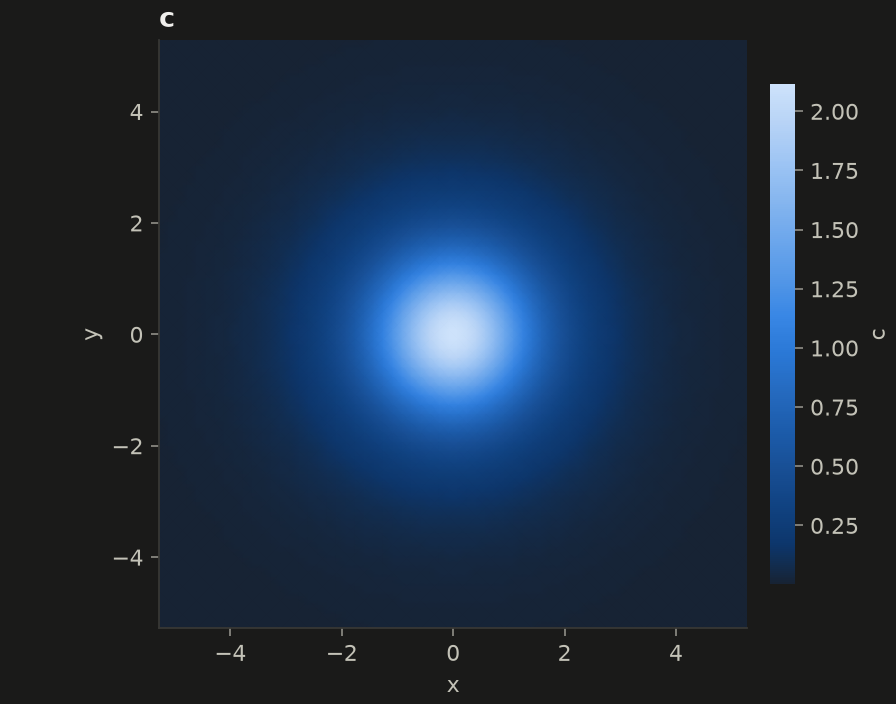
The Poisson–Boltzmann equation, \(-\nabla^2 c + \sinh c = \rho\), in the plane across a rod that carries the charge \(\rho\). In an electrolyte the ions of opposite charge gather around the rod and screen it. Their density follows the potential exponentially, which makes the equation nonlinear. Where the potential is small, \(\sinh c\) is nearly \(c\), and the equation is the screened Poisson equation of a screened charge. Where it is large, the screening is stronger: the potential at the rod is 2.11 here, and the linear equation would give 2.66.
What pdemagic decided
A term that is nonlinear in the unknown is solved by Newton’s method,
from zero (fourier_newton), here in five steps. Each step is a linear
equation with a coefficient that varies, solved by an iteration on the
Fourier method. The grid has 64 by 64 points, on a box around the rod.