A cloud of ions in a dish
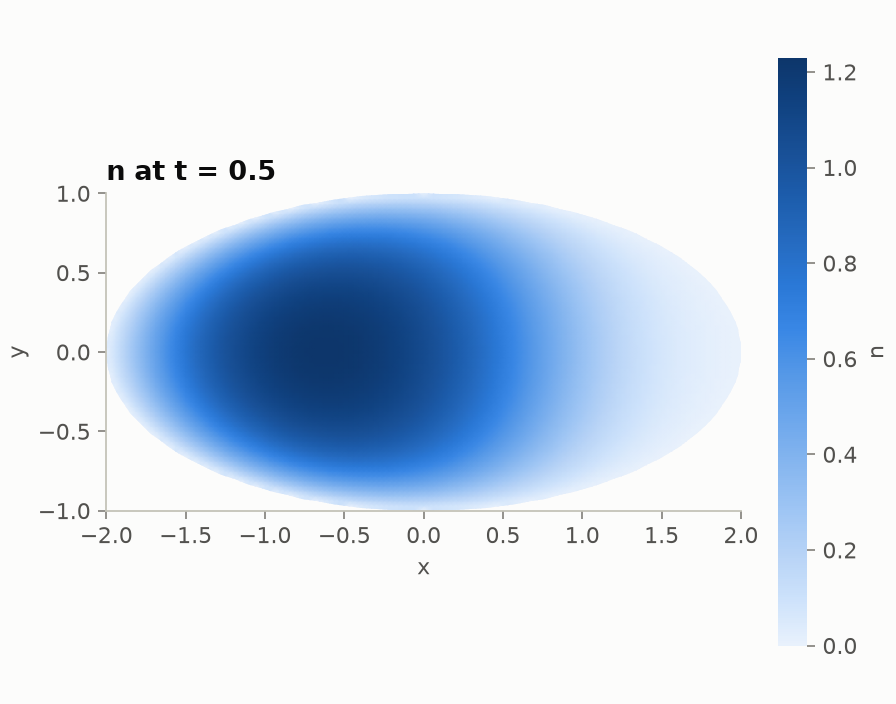
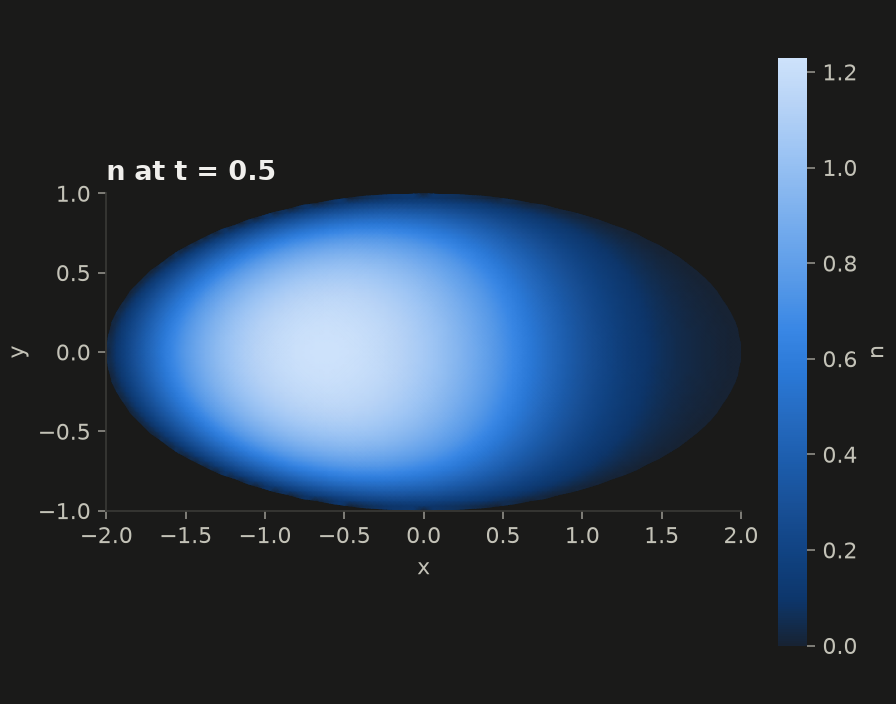
A cloud of ions in a grounded dish with the shape of an ellipse, after it has pushed itself apart for half a unit of time.
import sympy as sp
import pdemagic as pm
from pdemagic import curves

x, y, t = sp.symbols("x y t", real=True)
n = sp.Function("n")(x, y, t)
phi = sp.Function("phi")(x, y, t)

dish = pm.Region(x, y, curves.Ellipse((0, 0), (2, 1)))
drift = n.diff(x) * phi.diff(x) + n.diff(y) * phi.diff(y) - n**2
cloud = pm.Problem(
    sp.Eq(n.diff(t), pm.laplacian(n) / 4 + drift),
    sp.Eq(pm.laplacian(phi), -n),
    domain=dish,
    time=(t, 0, 0.5),
    initial={n: 8 * (1 - x**2 / 4 - y**2) ** 2 * sp.exp(-((x + 1) ** 2))},
    boundary=[sp.Eq(n, 0), sp.Eq(phi, 0)],
)
plan = pm.plan(cloud)
plan.method.tolerance = 1e-5
pm.solve(cloud, plan).plot(unknown=n, time=0.5)
What it shows
The cloud of ions between two plates, in a dish of any shape. Ions of one sign diffuse and drift in their own field: the potential \(\varphi\) obeys Poisson’s equation with their density \(n\) as its source at every instant, and the rim is grounded and takes the ions that reach it.
The drift of the ions is \(\nabla\cdot(n\,\nabla\varphi)\), which is \(\nabla n\cdot\nabla\varphi + n\,\nabla^2\varphi\), and with Poisson’s equation \(\nabla n\cdot\nabla\varphi - n^2\): that is how the example writes it, because a term that is stepped on a shape holds first derivatives at most.
The cloud starts near the left end with a peak of 5.7. It repels itself, and at the time 0.5 it has spread over half of the dish, with a peak of 1.2, and leans towards the middle, away from the rim that is close to it.
What pdemagic decided
One equation in time and a constraint on a shape are stepped together
(element_stepping), on 36 quadrilaterals of the degree 6 with 1 357
points. Each unknown has its own modes of the shape, from a dense
eigenproblem. The diffusion of \(n\) is exact in its modes, the drift is
stepped, and at every evaluation of it the constraint is solved for
\(\varphi\) in the modes of \(\varphi\). The plan says that this is the
finest mesh on which the planner has a system stepped, and that it
holds the start to \(5\cdot10^{-3}\) of its size. The example loosens the
tolerance of a step to \(10^{-5}\), which is in keeping with that and
takes 20 steps.