A wave through a slit
A pulse of sound in a room with a partition: what passes the slit leaves it as a new wave that spreads to all sides.
import sympy as sp
import pdemagic as pm
from pdemagic import curves

x, y, t = sp.symbols("x y t", real=True)
w = sp.Function("w")(x, y, t)
corners = [(0, 0), (0.8, 0), (0.8, 0.6), (1, 0.6), (1, 0), (2.4, 0)]
corners += [(2.4, 1.6), (1, 1.6), (1, 1), (0.8, 1), (0.8, 1.6), (0, 1.6)]

room = pm.Problem(
    sp.Eq(w.diff(t, 2), pm.laplacian(w)),
    domain=pm.Region(x, y, curves.Polygon(*corners)),
    time=(t, 0, 1),
    initial={w: sp.exp(-30 * ((x - 0.4) ** 2 + (y - 0.8) ** 2)), w.diff(t): 0},
    boundary=sp.Eq(pm.normal_derivative(w), 0),
)
plan = pm.plan(room)
plan.method.degree = 6
sound = pm.solve(room, plan)
sound.plot()
film = sound.animate()
What it shows
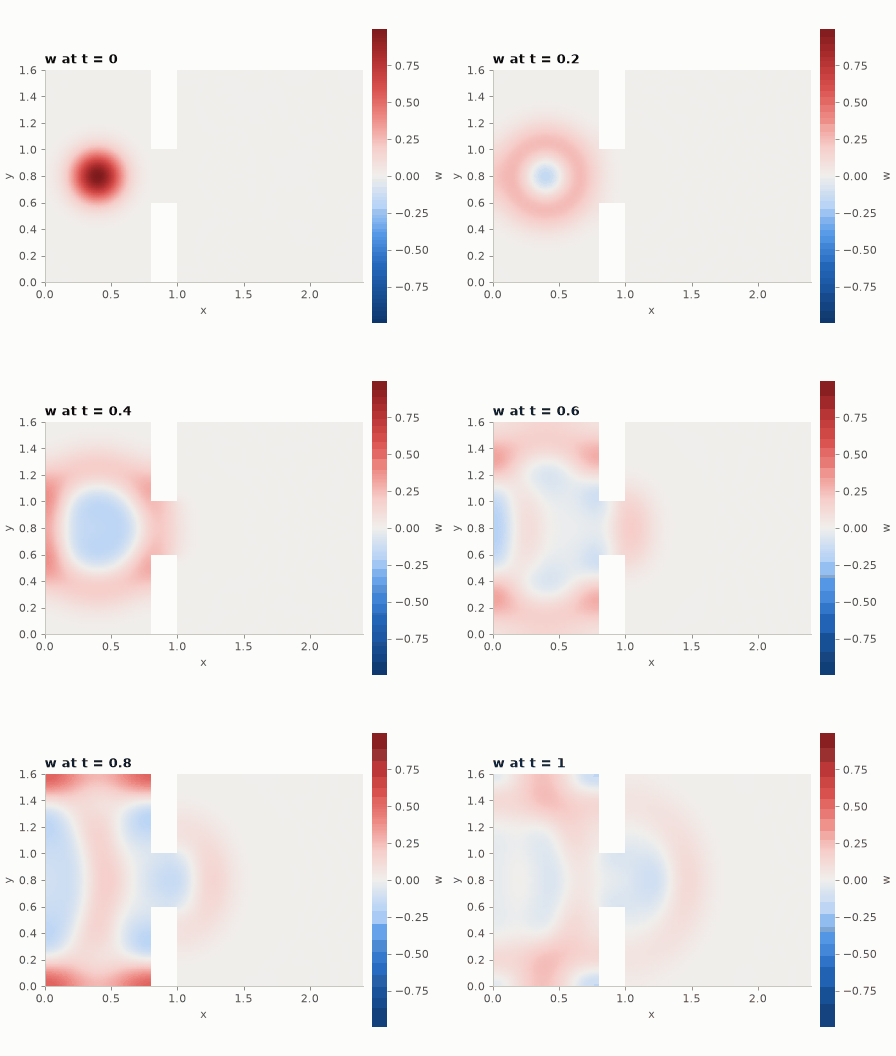
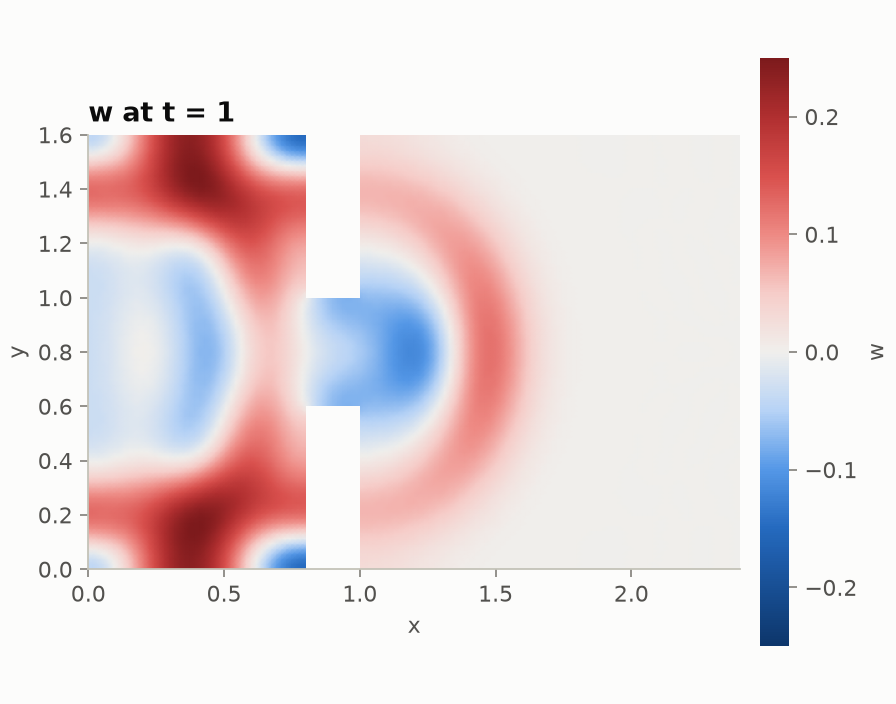
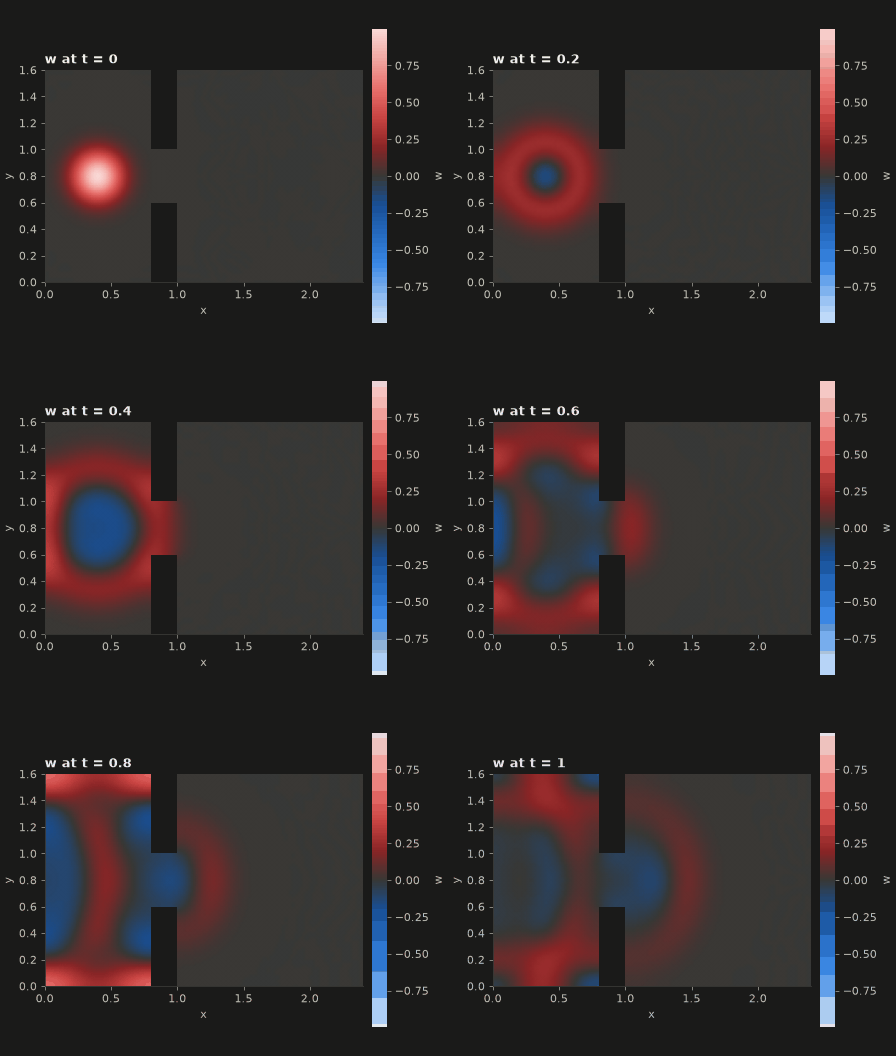
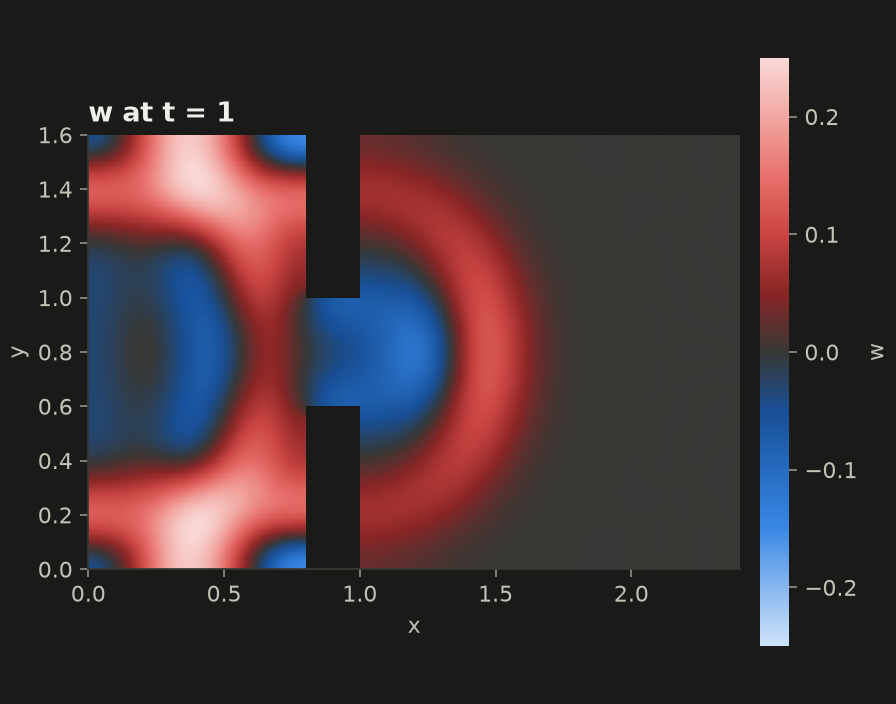
The wave equation on a region that one polygon bounds: a room of 2.4 by 1.6 with a partition that has a slit in the middle. The walls are hard: the slope of the pressure along the normal is zero on all of them. A pulse starts in the left part and spreads as a ring. The picture shows the last recorded time, when the walls of the left part have thrown the ring back and a part of it has passed the slit. Behind the slit it does not go on as a beam: it spreads as half a ring, as if the slit were its source. That is diffraction.
What pdemagic decided
The planner chose exact propagation in the modes of the shape
(element_propagator), on 48 quadrilaterals. The modes come from one
dense eigenproblem, which takes eight times as long for twice the
points, so the plan lowers the degree of the polynomials from the
planner’s 8 to 6, which makes the page five times faster. The diagnostic
solution_tail is then about \(2\cdot10^{-2}\): enough for a picture, and
not for digits. In a problem in time the mesh does not shrink towards
the corners of the partition, which costs accuracy there as well.