A quantum wave packet
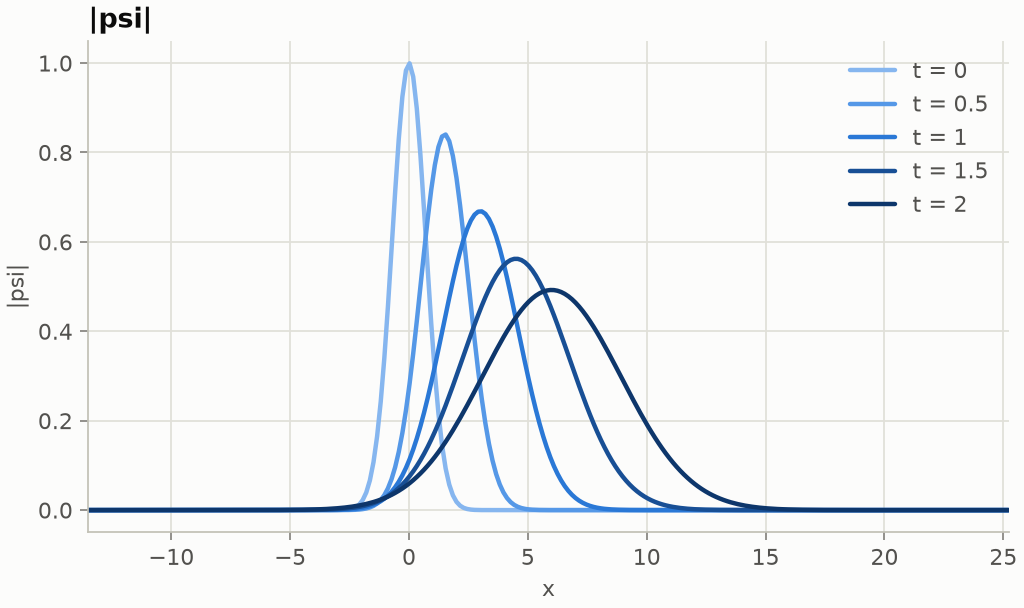
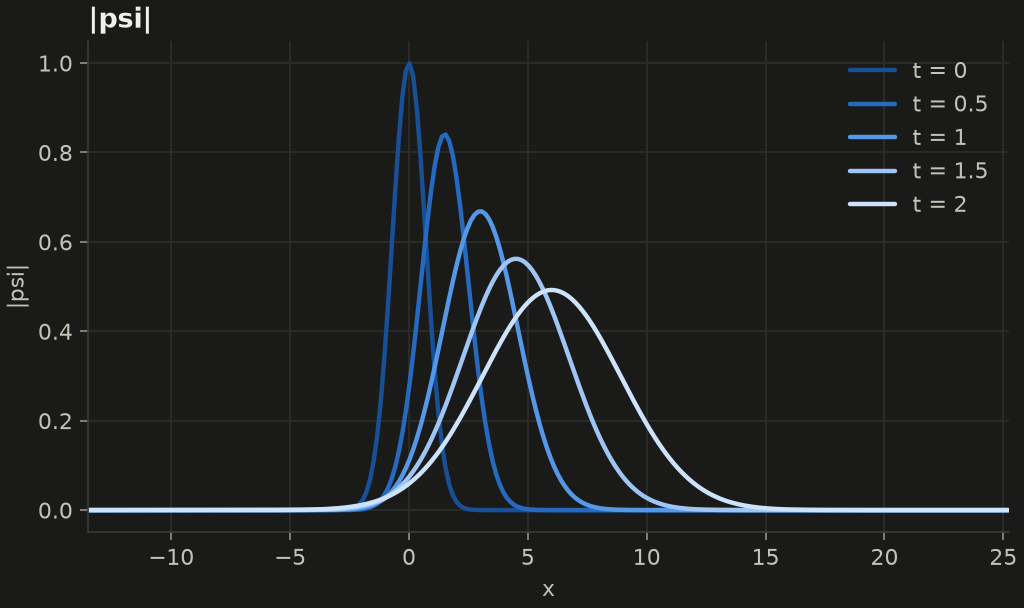
The magnitude of the wave function of a free particle at five times: the packet moves and spreads.
import sympy as sp
import pdemagic as pm

x, t = sp.symbols("x t", real=True)
psi = sp.Function("psi")(x, t)

particle = pm.Problem(
    sp.Eq(sp.I * psi.diff(t), -psi.diff(x, 2) / 2),
    domain=pm.FreeSpace(x),
    time=(t, 0.0, 2.0),
    initial={psi: sp.exp(-(x**2) + 3 * sp.I * x)},
)
pm.solve(particle).plot()
What it shows
The Schrödinger equation of a free particle, \(i\,\psi_t =
-\tfrac12\psi_{xx}\). An equation that contains sp.I has a complex
unknown, and a plot shows its magnitude. The factor \(e^{3ix}\) gives the
packet the speed 3, so it moves to the right. It also spreads, because
its short waves run faster than its long ones, and it sinks as it
widens: the total probability stays what it was.
What pdemagic decided
The planner chose exact propagation in Fourier space
(fourier_propagator): each of the 21 recorded times is exact in time.
The box is not symmetric. It reaches from \(-13.5\) to \(25.2\), as far as
the waves of the packet travel by the end of the time span, down to
those with \(10^{-6}\) of the largest amplitude, with 256 points.