The tones of a room
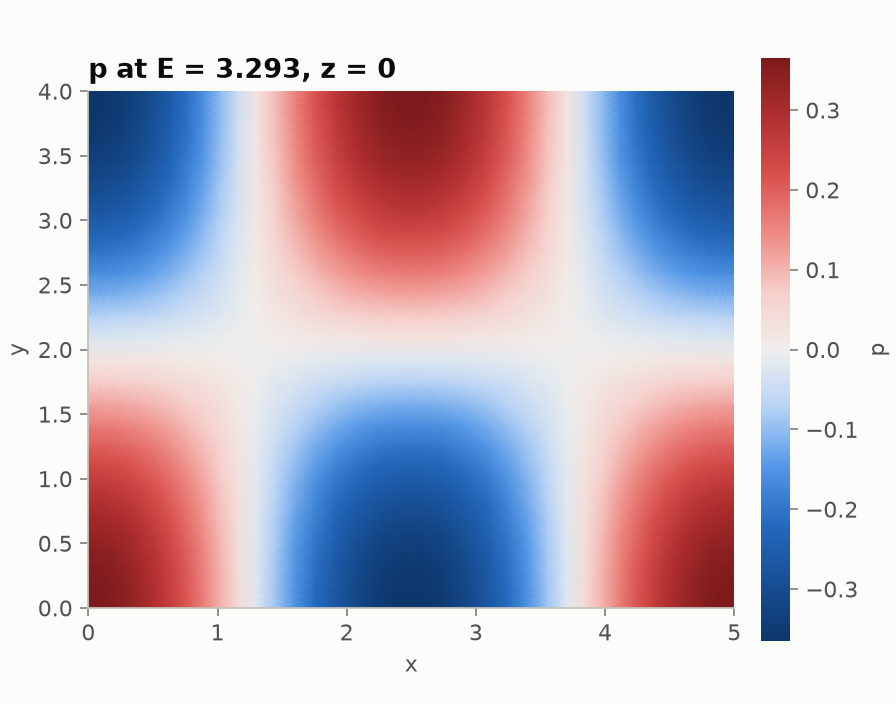
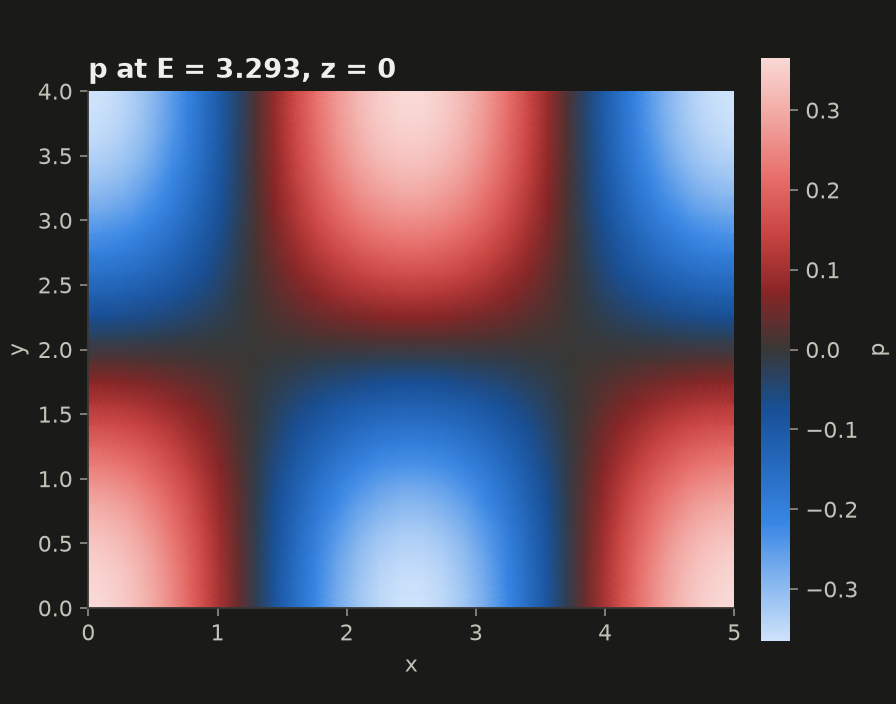
One of the lowest tones of a room with hard walls: the pressure on the floor, with two nodes along the room and one across it.
import sympy as sp
import pdemagic as pm

x, y, z = sp.symbols("x y z", real=True)
E = sp.Symbol("E")
p = sp.Function("p")(x, y, z)
sides = {x: (0, 5), y: (0, 4), z: (0, 3)}
hard = {(axis, end): sp.Eq(p.diff(axis), 0) for axis in sides for end in sides[axis]}

room = pm.Problem(
    sp.Eq(-pm.laplacian(p), E * p),
    domain=pm.Box(sides),
    boundary=hard,
    eigenvalue=(E, 14),
)
pm.solve(room).plot(state=13, cut={z: 0})
What it shows
The modes of a box of 5 by 4 by 3 in which sound stands: the pressure
obeys \(-\nabla^2 p = E\,p\), and has no slope along the normal on a hard
wall. Each face takes its condition, and the mapping hard gives the
same one to all six. A room sounds at the frequencies \(c\sqrt{E}/2\pi\)
for the eigenvalues \(E\) of its modes. They are \(\pi^2(l^2/25 + m^2/16 +
n^2/9)\) for whole numbers \(l\), \(m\) and \(n\), and the lowest is zero, for
the constant. The picture shows the fourteenth, with \(l = 2\), \(m = 1\)
and \(n = 1\), on the floor: cut= chooses the plane that is drawn.
Along the lines where the two colours meet the tone is silent.
What pdemagic decided
The planner chose the modes of the box (collocation_modes): they are
products of the modes of its three axes, from collocation at Chebyshev
points, sorted by their eigenvalue. That takes milliseconds. The grid
has 48 by 38 by 29 points, the coarsest on which every mode that is
asked for is resolved.