A string on a bed that hardens
A pulse runs along a string whose bed hardens where the string has moved, at five times.
import sympy as sp
import pdemagic as pm

x, t = sp.symbols("x t", real=True)
u = sp.Function("u")(x, t)
w = sp.Function("w")(x, t)

pulse = sp.exp(-((x - 8) ** 2) / 2)
string = pm.Problem(
    sp.Eq(u.diff(t, 2), u.diff(x, 2) - w * u / 2),
    sp.Eq(w.diff(t), w.diff(x, 2) / 10 + u**2),
    domain=pm.Box({x: (0, 40)}),
    time=(t, 0, 24),
    initial={u: pulse, u.diff(t): -pulse.diff(x), w: 0},
    boundary=[sp.Eq(u, 0), sp.Eq(w.diff(x), 0)],
)
plan = pm.plan(string)
plan.method.tolerance = 1e-6
pm.solve(string, plan).plot(unknown=u)
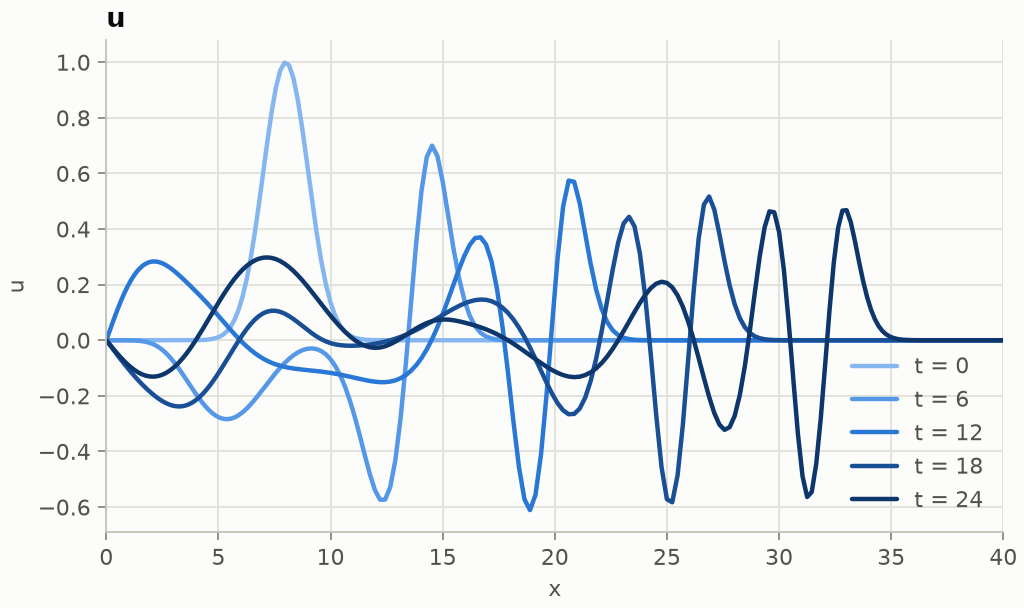
What it shows
A string lies on a bed that pulls it back to rest, with a stiffness \(w\) that is zero at the start. Where the string is deflected the bed warms and hardens, at the rate \(u^2\), and the warmth spreads slowly along it.
A pulse starts at \(x = 8\) and runs to the right with the speed 1. On a soft bed it would keep its shape. This one hardens the bed under itself as it passes, and the hardened bed changes it: its front still runs at the speed 1, but behind the front a train of waves forms, shorter towards the front, and a part of the pulse is thrown back and stays behind as a slow swell.
The two equations are of different kinds. The string obeys an equation of second order in time, a wave equation, and the stiffness one of first order, a diffusion. Each acts on the other through a term without a derivative.
What pdemagic decided
A wave and a diffusion between walls are stepped together
(exponential_runge_kutta). Each unknown is expanded in its own modes
of the box, \(u\) with the ends held and \(w\) with the ends closed. The
wave equation is exact, for \(u\) and its rate of change together, and so
is the diffusion of \(w\). The two terms that couple them are stepped.
The grid has 256 Chebyshev points. The example loosens the tolerance of
a step to \(10^{-6}\), which is plenty for a picture and takes 80 steps
where the planner’s \(10^{-10}\) takes 640. The diagnostic
solution_tail is \(5\cdot10^{-6}\) at the end: the waves behind the
front are the finest thing in the picture, and a finer grid would
resolve them further.