A double well
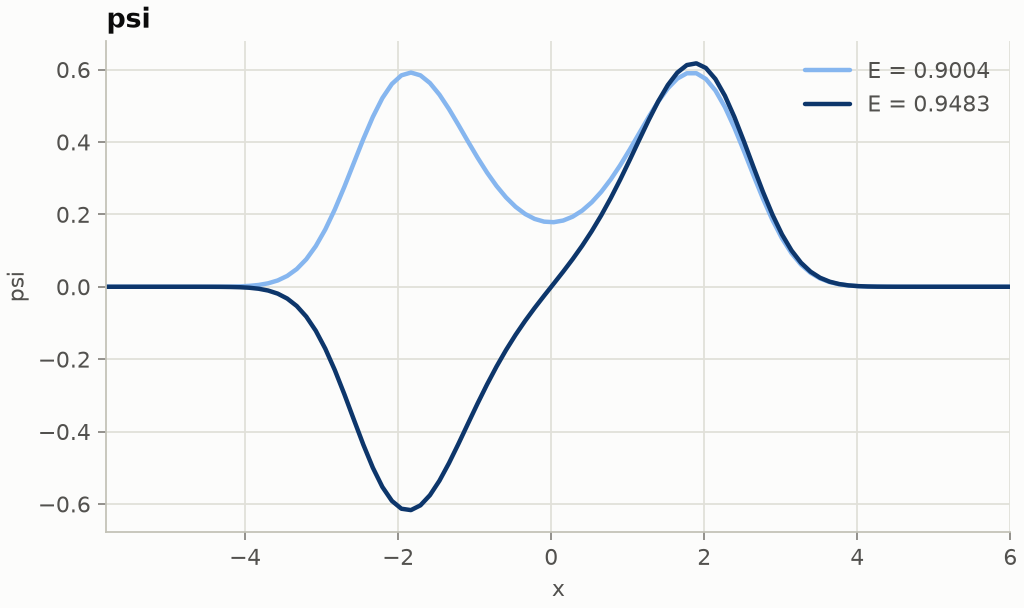
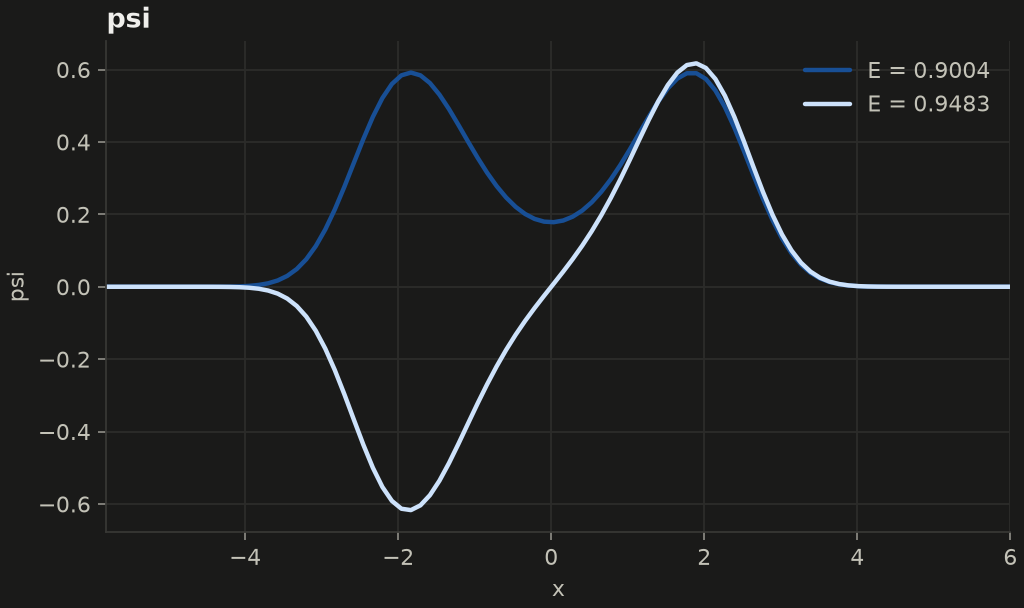
The two lowest states of a particle in a well with two minima: one is even, one is odd, and tunnelling splits their energies.
import sympy as sp
import pdemagic as pm

x = sp.symbols("x", real=True)
E = sp.Symbol("E")
psi = sp.Function("psi")(x)

wells = pm.Problem(
    sp.Eq(-psi.diff(x, 2) / 2 + (x**2 - 4) ** 2 / 8 * psi, E * psi),
    domain=pm.FreeSpace(x),
    eigenvalue=(E, 2),
)
pm.solve(wells).plot()
What it shows
The potential \((x^2 - 4)^2/8\) has a minimum at \(x = -2\) and one at \(x = 2\), with a barrier of the height 2 between them. Near each minimum it is the well of an oscillator whose lowest energy is 1, below the top of the barrier. A particle with that energy cannot cross the barrier in classical mechanics, but in quantum mechanics it tunnels, and the states belong to both wells at once. The lowest has the same sign in both, and the energy 0.9004. The next has opposite signs, a node in the middle, and the energy 0.9483. The difference of 0.048 is the tunnel splitting: a particle that starts in one well is in the other after the time \(\pi/0.048\).
What pdemagic decided
The planner chose a block iteration for the lowest eigenvalues, with
the second derivative applied in Fourier space (fourier_subspace). In
free space it also chose the box: from \(-5.8\) to \(6.0\), where both
states have faded to \(2\cdot10^{-11}\) of their largest value, with 96
points.