Let waves out through a wall
Use this when a wave of one frequency should leave the domain through a face without being thrown back: the open end of a duct, a window.
Steps
Write the Helmholtz equation with the wave number \(k\) as a number:
pm.laplacian(w) + k**2 * w.On the open face give the condition \(\partial w/\partial n - i k\,w = 0\):
sp.Eq(pm.normal_derivative(w) - sp.I * k * w, 0).Give the other faces their conditions and solve. The solution is complex.
Example
A duct with hard walls above and below. A wave is driven at its left end and leaves through its right end:
import numpy as np
import sympy as sp
import pdemagic as pm

x, y = sp.symbols("x y", real=True)
w = sp.Function("w")(x, y)
k = 7

duct = pm.Box({x: (0, 2), y: (0, 1)})
hard = sp.Eq(pm.normal_derivative(w), 0)
walls = {
    (x, 0): sp.Eq(w, 1),  # driven
    (x, 2): sp.Eq(pm.normal_derivative(w) - sp.I * k * w, 0),  # open
    (y, 0): hard,
    (y, 1): hard,
}
leaving = pm.solve(
    pm.Problem(sp.Eq(pm.laplacian(w) + k**2 * w, 0), domain=duct, boundary=walls)
)
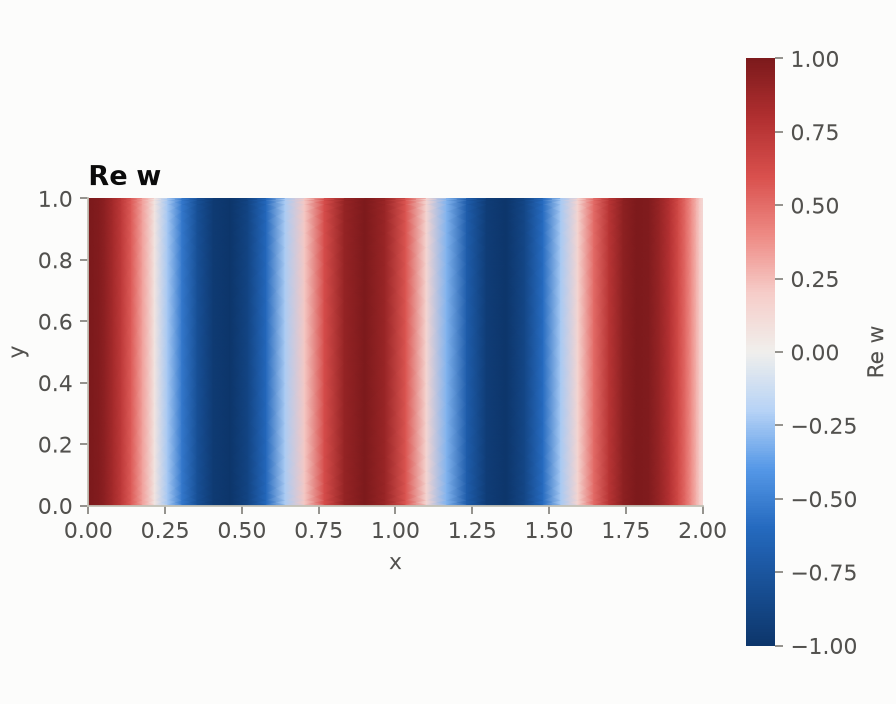
leaving.plot(part="real")

assert leaving[w].dtype == complex
# Nothing comes back: the wave is exp(ikx), with the amplitude 1 everywhere.
X, Y = leaving.mesh()
assert abs(leaving[w] - np.exp(1j * k * X)).max() < 1e-10
Notes
The sign belongs to the time dependence \(e^{-i\omega t}\), in which \(e^{ikx}\) travels towards larger \(x\). With \(+ik\) in the condition the wave would come in.
The condition is exact for a wave that meets the wall head-on. A wave that arrives at an angle is partly reflected.
The same condition works on a face of a round domain and on a piece of the boundary of a shape in the plane.
It is for waves of one frequency. A condition cannot hold a derivative in time yet, so a problem in time has no wall that lets waves out.
In free space no wall is needed: pdemagic returns the solution in which the sources send waves out and nothing comes in.
Waves of one frequency explains the equation and Complex unknowns the result. The gallery has a room with an open window and a harbour.