A plate that rings
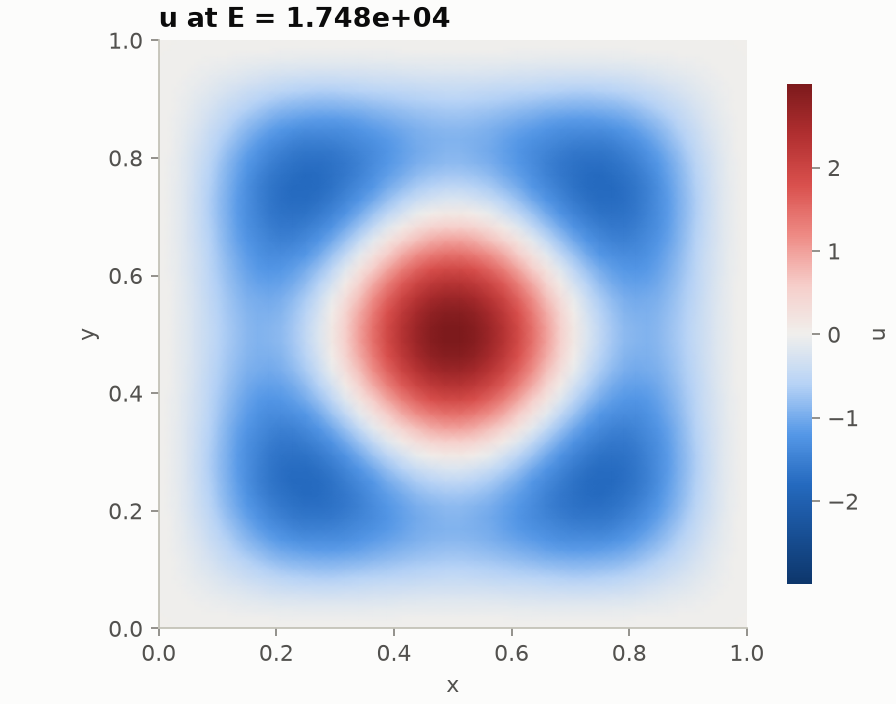
A tone of a square plate that is clamped along its sides: where the two colours meet the plate stays at rest, and sand on it would gather.
import sympy as sp
import pdemagic as pm

x, y = sp.symbols("x y", real=True)
E = sp.Symbol("E")
u = sp.Function("u")(x, y)
clamped = [sp.Eq(u, 0), sp.Eq(pm.normal_derivative(u), 0)]

plate = pm.Problem(
    sp.Eq(pm.laplacian(pm.laplacian(u)), E * u),
    domain=pm.Box({x: (0, 1), y: (0, 1)}),
    boundary=clamped,
    eigenvalue=(E, 6),
)
pm.solve(plate).plot(state=5)
What it shows
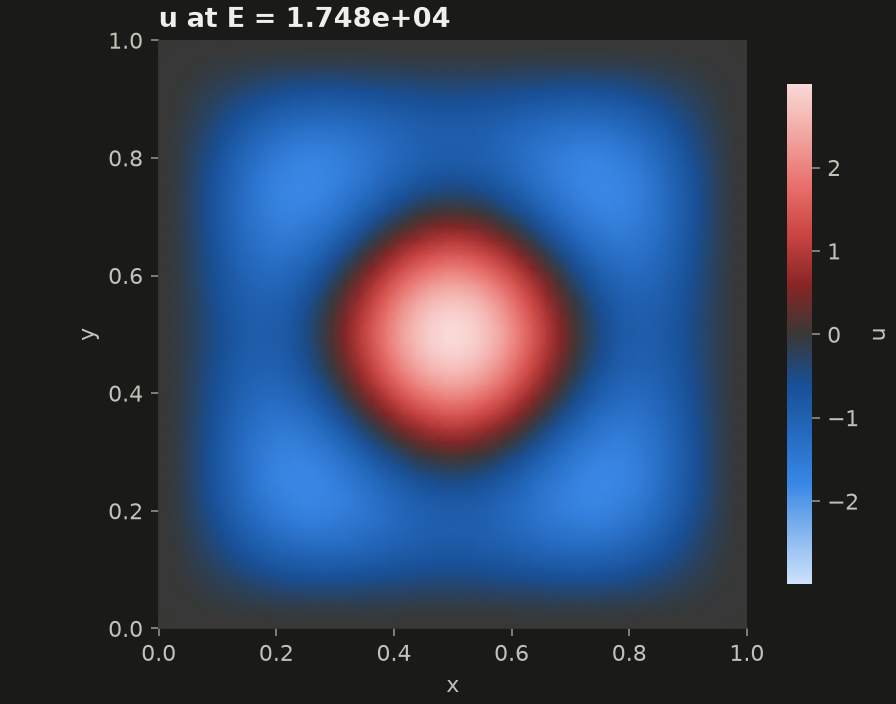
The modes of a plate obey \(\nabla^4 u = E\,u\), and the plate sounds at frequencies that go with \(\sqrt{E}\). A clamped side holds the value and the slope, so every mode leaves the sides flat. The picture is the sixth mode, with \(\sqrt{E} = 132.2048\): a ring around the middle that moves against it. The fifth, at \(131.5808\), is its partner: four lobes of alternating sign around a middle that stays at rest. No formula gives these modes. The roots of the first five eigenvalues are 35.9852, 73.3938 twice, 108.2165 and 131.5808, the numbers that the books on plates give.
What pdemagic decided
The modes of a plate are no products of the modes of its two axes, so
no transform finds them. The planner took them from the stationary
solve of the plate (collocation_inverse_modes): an iteration on a
block of functions applies that solve, and keeps the functions that it
maps to multiples of themselves. It took 23 steps on a grid of 64 by 64
points.