Integrate a solution
Use this when you need the integral of an unknown over its domain: the heat that a plate holds, the total of a substance, a mean value.
Steps
Call
solution.integral(). It returns the integral of the unknown over the domain, as a number.For a problem in time, read the result as an array with one integral for each recorded time.
With several unknowns, name the one you mean:
solution.integral(a).
Example
A rod that is hot in the middle and kept cold at both ends. Its heat leaves through the ends:
import numpy as np
import sympy as sp
import pdemagic as pm

x, t = sp.symbols("x t", real=True)
T = sp.Function("T")(x, t)

rod = pm.Problem(
    sp.Eq(T.diff(t), T.diff(x, 2)),
    domain=pm.Box({x: (0, 1)}),
    time=(t, 0, 0.2),
    initial={T: sp.sin(sp.pi * x)},
    boundary=sp.Eq(T, 0),
)
cooling = pm.solve(rod)
cooling.plot()

heat = cooling.integral()
assert heat.shape == cooling.times.shape  # one integral for each time
# The integral of sin(πx) is 2/π, and it decays at the rate π².
exact = 2 / np.pi * np.exp(-(np.pi**2) * cooling.times)
assert abs(heat - exact).max() < 1e-12

# What is left of the heat at the end.
left = heat[-1] / heat[0]
assert abs(left - np.exp(-0.2 * np.pi**2)) < 1e-12
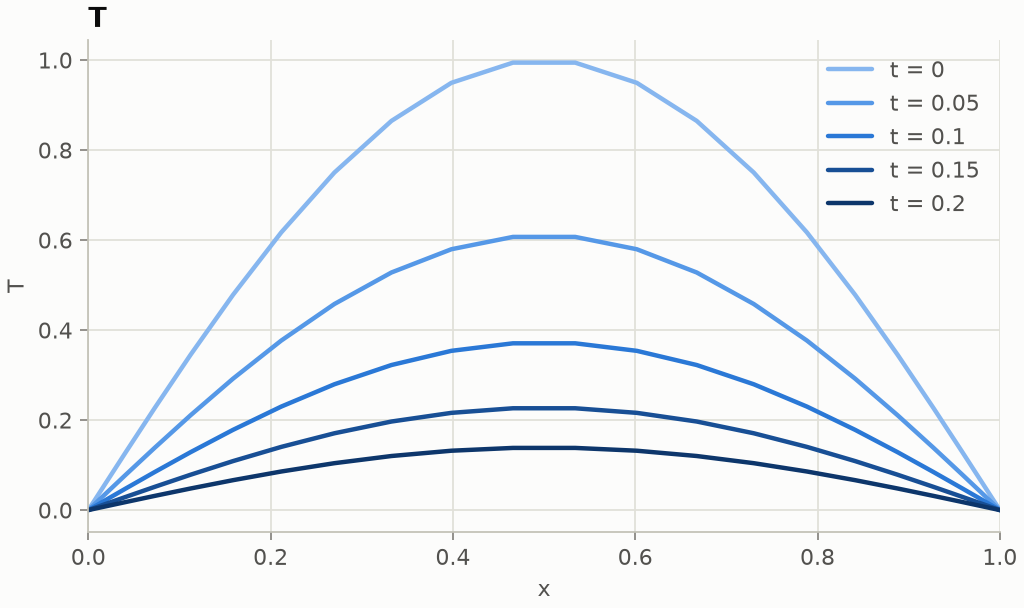
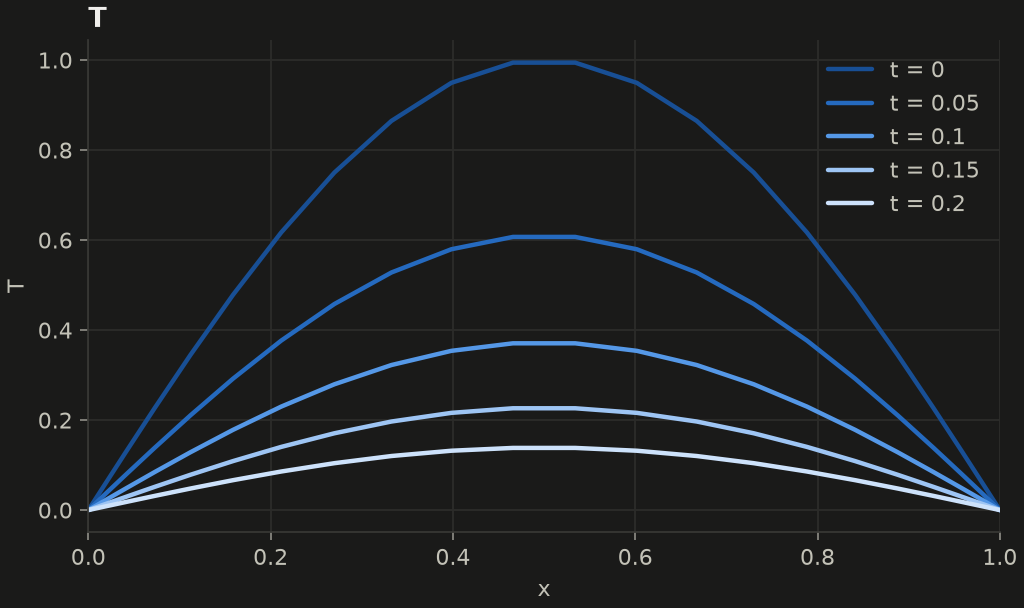
Notes
The integral is taken by the quadrature of the points of the grid, and for a resolved solution it is exact up to rounding. No values are interpolated.
The coordinates of the domain bring their measure: on a disk the integral is over its area, in a ball and a cylinder over the volume. On a shape in the plane it is over the shape, up to its boundary.
Where a direction is free, the integral is over the box of the grid, not over all of space. For a solution that has not faded at the faces of the box it depends on the box.
Only an unknown itself is integrated. For the integral of its square or of its energy, take the arrays: see Get the arrays and the grid.
For an eigenproblem the result holds one number for each state.
Solutions explains what a solution offers, and the page about the methods says how values and integrals are taken.