Note
Go to the end to download the full example code.
Power law: vacuum diode#
In a vacuum diode, the space-charge limited anode current follows the Child–Langmuir law I = k · U^(3/2). Fitting a general power law tests whether the exponent really is 3/2.
import numpy as np

import fitwise as fw

rng = np.random.default_rng(10)
voltage = np.linspace(10, 200, 25)  # V
current = 0.018 * voltage**1.5 * (1 + rng.normal(0, 0.02, voltage.size))  # mA
dI = 0.02 * current

result = fw.fit(fw.models.powerlaw, voltage, current, yerr=dI)
print(result)
Model:      powerlaw(x; amp, exponent)
Method:     Trust Region Reflective (scipy least_squares) (auto: nonlinear)
Converged:  yes (14 evals)
Data:       25 points, yerr given (absolute)
Start:      amp, exponent: log-log fit

Parameter     Value   ± Std.Err    Rel.   Bounds
amp         0.01786     0.00041   2.3 %   –
exponent     1.5002      0.0051   0.3 %   –

χ²/ndf = 0.532 (23 dof, p = 0.97)    R² = 0.99976    AIC = -13.9
Correlations > 0.5:  amp–exponent (-0.98)
Warnings:   none
Is the exponent compatible with 3/2?
exponent = 1.5002 ± 0.0051, deviation from 1.5: +0.0 σ
If theory fixes the exponent, fix it and fit only the prefactor:
Model:      powerlaw(x; amp, exponent)
Method:     Trust Region Reflective (scipy least_squares) (auto: nonlinear)
Converged:  yes (11 evals)
Data:       25 points, yerr given (absolute)
Start:      amp: log-log fit · exponent: fixed

Parameter      Value   ± Std.Err    Rel.   Bounds
amp         0.017871    0.000071   0.4 %   –
exponent         1.5           –       –   fixed

χ²/ndf = 0.51 (24 dof, p = 0.98)    R² = 0.99976    AIC = -15.9
Warnings:   none
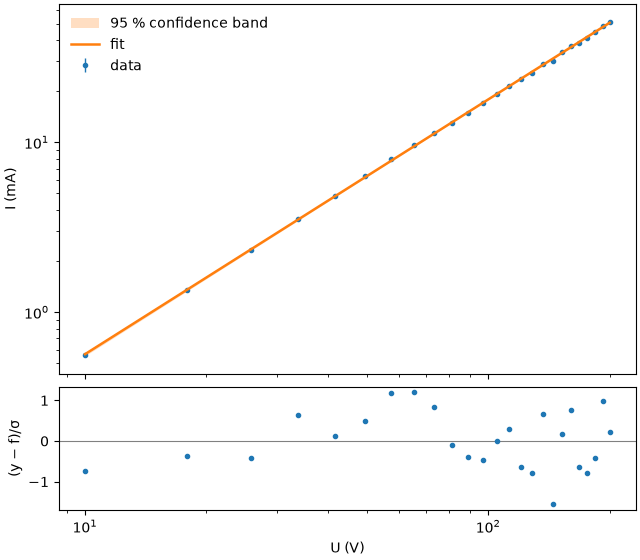
Text(0.5, 18.503588541666673, 'U (V)')
Total running time of the script: (0 minutes 0.182 seconds)